Why Scaling a Business Is Different from Starting One
Starting a business and scaling a business are not the same job
In the early stage, a company can survive on speed, improvisation, and founder control. Decisions are made quickly, inventory is tracked manually, suppliers are handled one by one, and the product range is still small enough to manage through spreadsheets, chat threads, and memory. That model can work for a while.
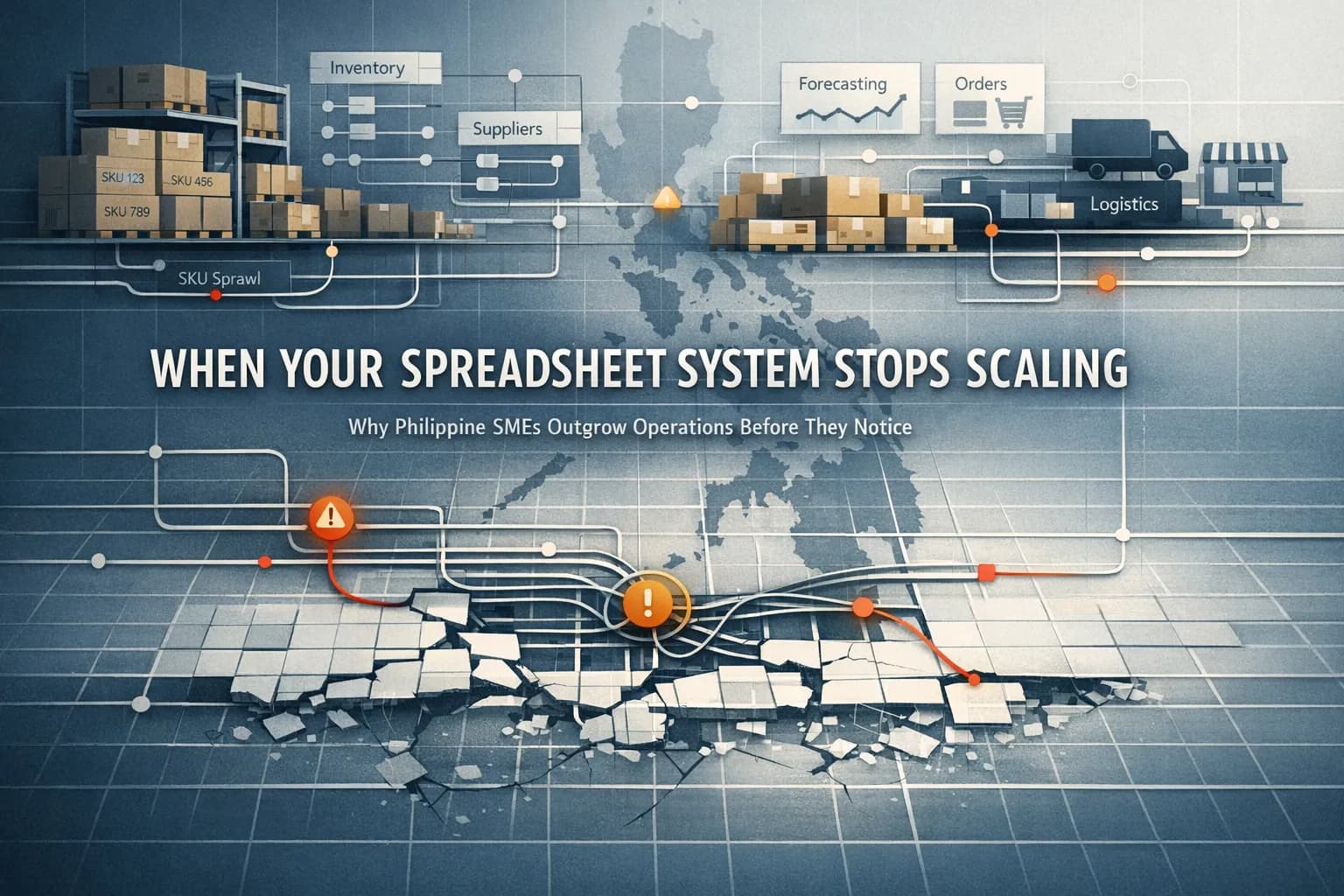
But scaling changes the operating environment. Once the business starts carrying more SKUs, working with more suppliers, serving more channels, and moving larger volumes, the same informal habits that helped the company start become the reason it stalls. This is not theory. McKinsey cites research suggesting that 78% of companies that reach product-market fit still fail to scale.
That matters in the Philippines, where MSMEs account for 99.5% of registered businesses and more than 65% of employment. For founders in retail, importing, distribution, and product-based trade, growth does not just increase revenue potential. It increases operational complexity, coordination risk, and the cost of weak systems.
The problem is straightforward: many entrepreneurs prepare to launch, but far fewer prepare to operate at scale.
Starting and Scaling Are Two Different Phases of Business
Starting rewards speed and founder control
Most small businesses begin with concentrated decision-making. The founder approves purchases, negotiates with suppliers, checks inventory, handles urgent customer issues, and solves exceptions in real time. In a small operation, this can look efficient because the organization is still simple.
At this stage, businesses often have:
- a narrow product catalog
- a limited supplier base
- few reporting layers
- informal approval and communication flows
- manual inventory and fulfillment tracking
Those conditions make informality possible. They do not make it scalable.
Scaling requires repeatability, not just hustle
Once the company grows, operating through founder instinct stops being a strength and starts becoming a bottleneck. McKinsey's framing is blunt: what got the company to early success is often no longer enough to sustain growth.
A founder-led setup struggles as soon as the business needs consistency across dozens or hundreds of repeated transactions. Growth demands a shift from solving problems one by one to building systems that solve the same class of problems repeatedly.
That transition is where many SMEs fail. They assume scaling is just doing more of what already worked. It is not. It is replacing informal control with structured execution.
Why Operational Complexity Increases During Growth
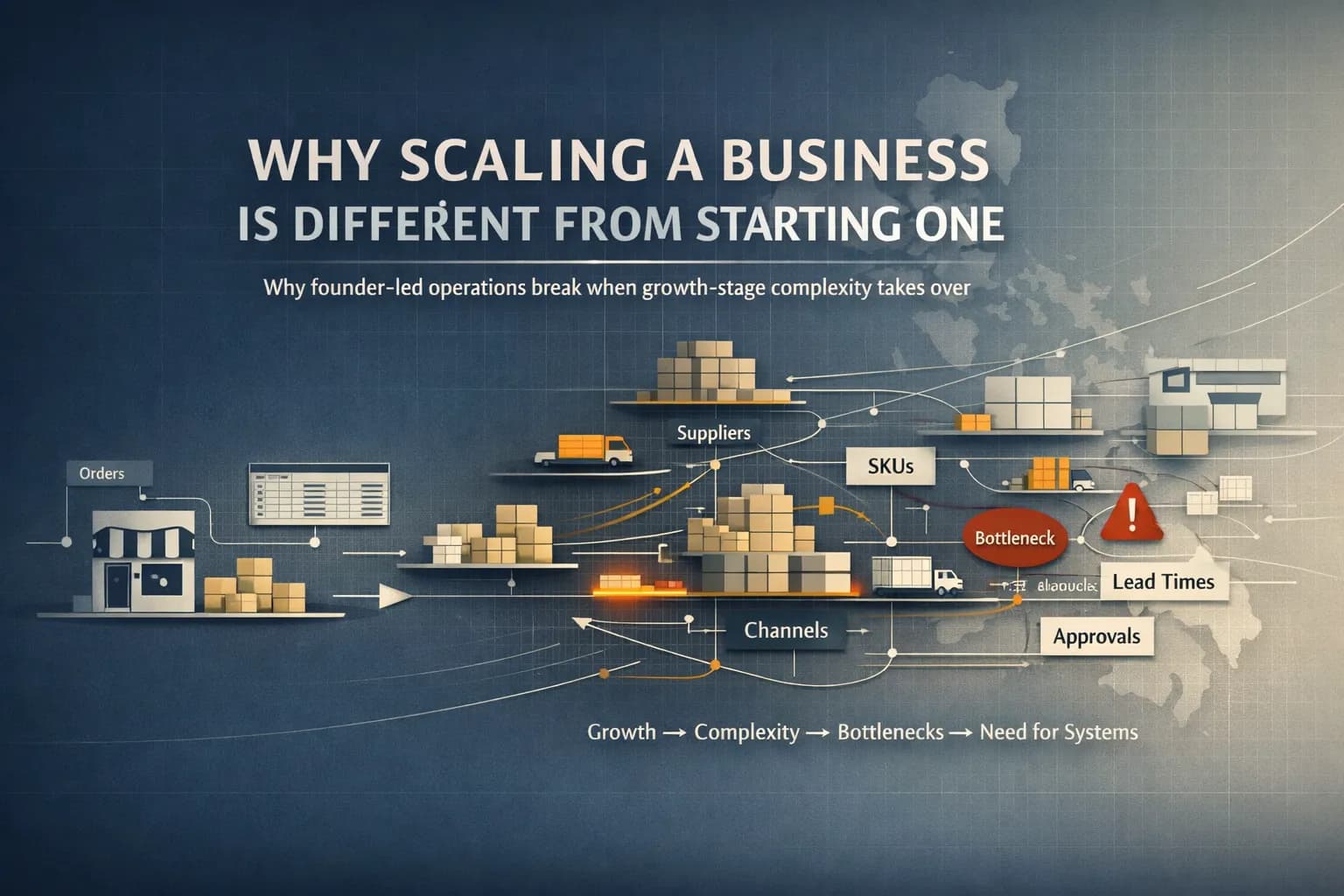
Growth does not arrive in a single form. It usually appears through multiple sources of complexity at the same time.
More suppliers
Each new supplier adds lead times, payment terms, quality risk, communication overhead, and procurement decisions. One supplier can often be managed by memory. Ten cannot.
More products and variants
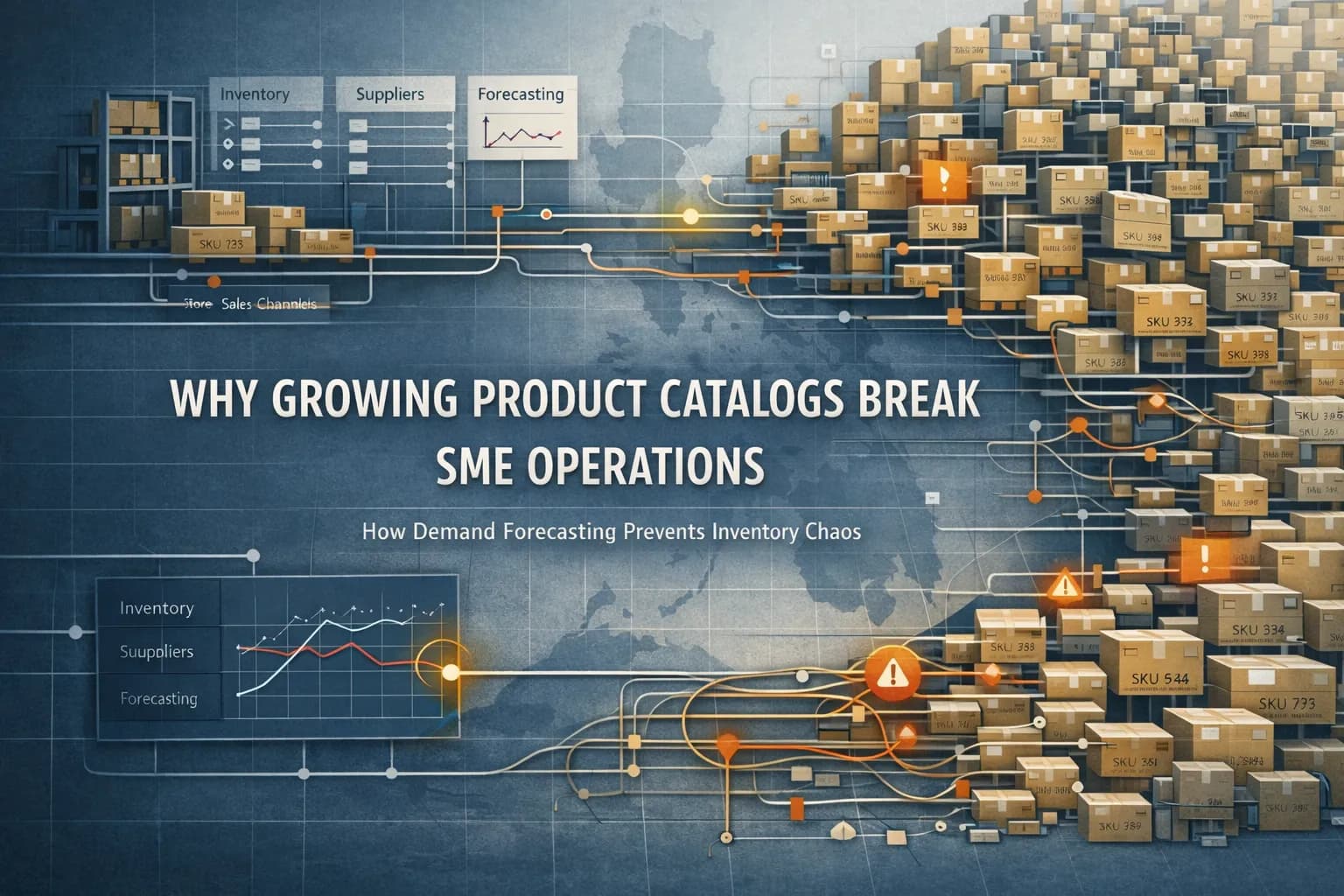
A business that begins with 20 or 30 SKUs can quickly expand into hundreds once it adds bundles, colors, sizes, models, seasonal items, or channel-specific assortments. Every new SKU creates additional forecasting, storage, replenishment, and reporting requirements.
More channels
Many Philippine businesses now sell through a mix of physical retail, Facebook, TikTok Shop, Shopee, Lazada, distributors, resellers, and direct B2B accounts. Revenue becomes more diversified, but operations become harder to synchronize. Stock accuracy, pricing control, and order fulfillment become multi-channel problems.
More coordination points
More people, more partners, and more handoffs mean more room for delay and error. What used to be solved by walking across the room now requires process ownership, documented workflows, and clear escalation paths.
This is why scaling companies often feel slower even when they are selling more. The business is not just bigger. It is structurally more complicated.
Inventory Growth Turns Into SKU Complexity Fast
Inventory is one of the first areas where growth-stage businesses lose control.
SKU count rises faster than most founders expect
In product-based businesses, adding revenue usually means adding assortment. A distributor adds categories. An importer adds variants. A retailer expands price points. The result is a larger inventory base that is harder to track and much harder to forecast.
Demand becomes less predictable
Early-stage sales patterns are often simple because the company is small. Once the business starts running promotions, entering new channels, or serving different customer segments, demand variability increases. Some SKUs move faster than expected. Others become dead stock.
Visibility weakens without systems
Manual inventory methods break under volume. When inventory is spread across spreadsheets, chat messages, warehouse notes, and marketplace dashboards, stock visibility becomes unreliable. That leads to stockouts, over-ordering, and poor cash allocation. Even local retail supply-chain commentary in the Philippines points to manual tracking as a persistent cause of slower decisions and inventory errors in growing operations.
This is where structured inventory systems stop being optional. A business needs a working method to answer basic operational questions quickly:
- What is actually available now?
- What is reserved?
- What is inbound?
- What is aging?
- Which SKUs should be reordered, reduced, or discontinued?
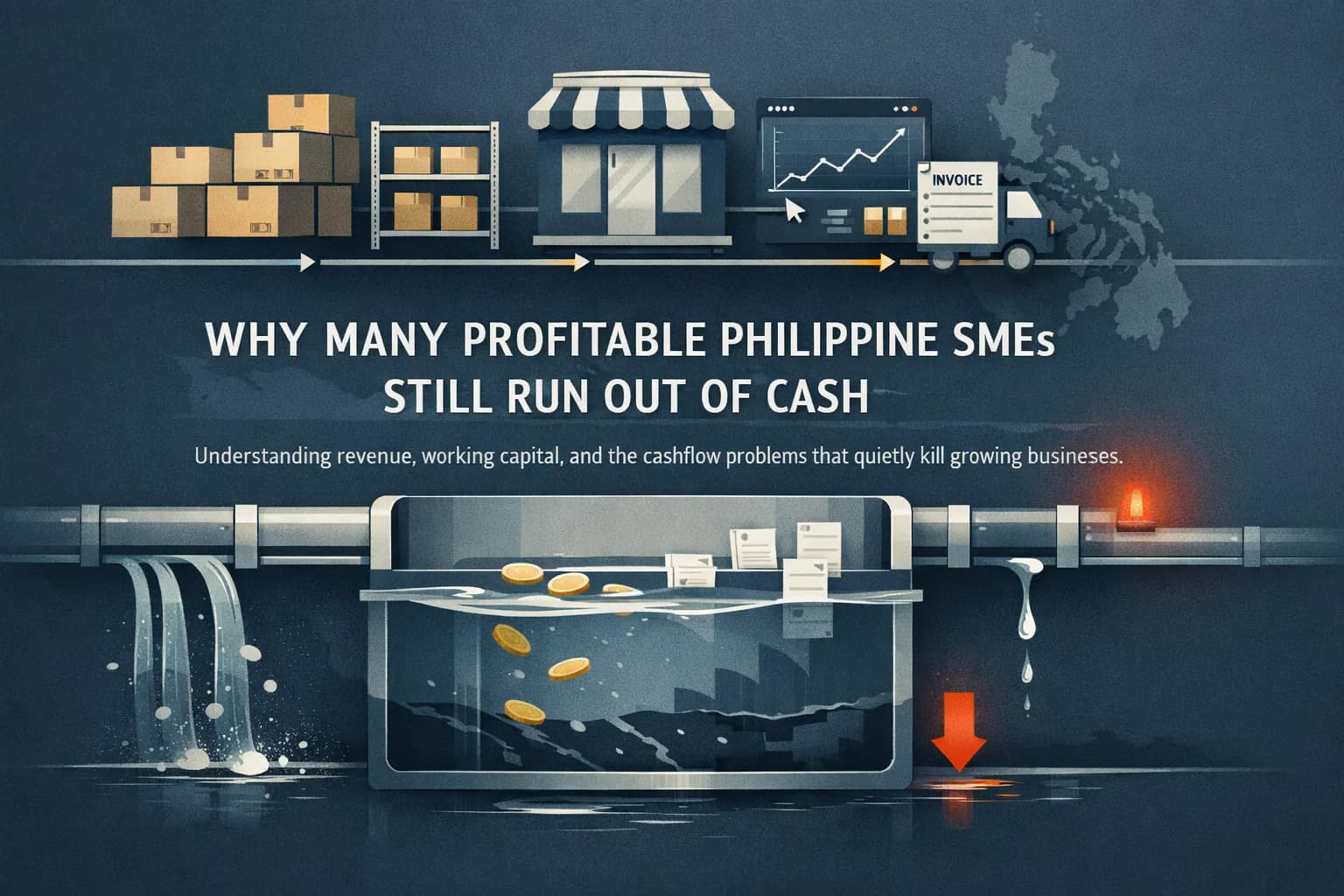
Without those answers, growth creates the illusion of momentum while quietly damaging cash flow.
Logistics and Supply Chain Complexity Increases With Scale
Scaling is not only about selling more units. It is about moving more goods, more often, through a more fragile chain of dependencies.
Larger shipment volumes create planning pressure
As order volumes rise, logistics becomes less forgiving. Shipment consolidation, freight booking, customs timing, container planning, local transport coordination, and warehouse receiving all start to matter more. A delay that was manageable at small scale becomes expensive at larger scale because it affects more inventory and more orders at once.
Multi-channel distribution adds friction
A company supplying retail stores, online orders, and dealer accounts at the same time is no longer dealing with one fulfillment model. It is running several. Each channel has different service expectations, packaging requirements, order cutoffs, and return patterns.
Warehouse coordination becomes a real management function
At small scale, warehousing can feel like storage. At growth stage, it becomes an operating system. Goods have to be received correctly, located correctly, counted correctly, picked correctly, and dispatched correctly. A warehouse that lacks process discipline turns growth into avoidable loss through shrinkage, mispicks, and delays.
Supplier lead times become strategic, not administrative
Many Philippine importers and distributors still underestimate lead-time risk until growth exposes it. A supplier delay no longer affects one purchase order. It affects replenishment timing, channel availability, campaign execution, and customer confidence.
That risk is harder to ignore in an environment where transport costs and supply-chain volatility remain material business concerns. Supply disruption is also not a fringe issue. US Chamber reporting, citing Anvyl survey data, notes that 79% of SMBs experienced supply-chain disruption effects after the pandemic and 56% changed suppliers because of delay and cost pressures.
For businesses that import, distribute, or maintain wide product catalogs, logistics is no longer a support function. It becomes part of margin protection.
Management Structure Has to Change as the Company Grows
Many founders assume operational problems are mainly caused by staff quality. In reality, a large share of growth-stage friction comes from structural ambiguity.
Role clarity becomes necessary
Once headcount increases, "everyone helps with everything" stops being flexible and starts being expensive. Procurement, sales operations, finance, inventory control, warehouse execution, and logistics coordination need defined ownership.
Without that clarity, common problems appear:
- purchase approvals stall
- decisions bounce between people
- exceptions are escalated back to the founder
- reporting becomes inconsistent
- mistakes repeat because nobody owns root-cause correction
Founder bottlenecks become more damaging
Growth-stage businesses often hit a ceiling because too many approvals, decisions, and operational exceptions still pass through the founder. Commentary from Mercury on business growing pains describes this pattern directly: as teams scale, decision rights often remain too centralized, and system weakness becomes more visible than talent weakness.
Reporting lines and operating rhythms matter
Scaling companies need recurring management routines. That includes inventory reviews, purchasing plans, inbound shipment monitoring, service-level checks, and cash-flow visibility. A business cannot scale on scattered updates and reactive chats alone.
This is the shift many entrepreneurs resist because it feels less entrepreneurial. But this is exactly the shift that protects the business from operational drift.
What Scalable Operations Actually Require
Businesses do not become scalable because they are busy. They become scalable because they are structured.
Procurement planning
Procurement should not be reduced to buying when stock runs low. It should connect forecasted demand, supplier lead times, order frequency, landed cost, and working-capital discipline. For businesses importing from China, this also means planning around seasonal factory shutdowns that can disrupt supply for weeks. Proper procurement planning reduces emergency buying, lowers avoidable freight premiums, and improves negotiating leverage with suppliers.
Supply chain coordination
Imports, replenishment, warehousing, and fulfillment need one operating view. That means knowing what is ordered, what is in transit, what has cleared, what is received, and what is available for sale. Once the business scales, fragmented supply-chain information becomes expensive fast.
Operational forecasting
Forecasting is not about perfect accuracy. It is about better decisions. Businesses need at least a practical demand-planning process tied to sales history, seasonality, promotions, and supplier constraints. In product-based trade, weak forecasting usually shows up in two places first: cash tied up in slow-moving stock and missed sales on fast-moving stock.
Inventory systems
A business does not necessarily need a complex ERP immediately, but it does need reliable inventory controls. That means SKU-level visibility, reorder logic, aging analysis, movement reporting, and channel-level stock discipline.
Documented process execution
Scalable companies define how purchasing, receiving, putaway, picking, dispatch, returns, and exception handling should work. Once those workflows are documented and consistently reviewed, operations become less dependent on individual memory.
This is also where companies like Luxium demonstrate practical value. Businesses that work closely with procurement, sourcing, import coordination, and distribution operations tend to see the same pattern repeatedly: early growth is usually constrained less by demand and more by execution quality. The issue is rarely just finding suppliers or moving products. The issue is building a system that can keep doing both reliably as complexity increases.
What Philippine SMEs Should Do Before Growth Turns Into Chaos
For founders running retail, importing, distribution, or product-based businesses, the practical takeaway is simple: build operating discipline before the business is forced into it.
That usually means:
- cleaning up SKU structure before the catalog becomes too wide to manage
- setting reorder rules based on lead times and actual movement
- tracking inbound shipments with more discipline
- separating procurement, inventory control, and warehouse responsibilities
- establishing regular reporting for stock, sell-through, aging, and service issues
- reducing dependence on the founder for routine approvals and operating decisions
None of this is glamorous. That is the point. Scaling is less about inspiration and more about operational design.
Conclusion
Starting a business rewards improvisation. Scaling a business punishes it.
In the startup phase, informality can help a company move fast. In the growth phase, the same informality creates blind spots in inventory, procurement, logistics, decision-making, and accountability. That is why so many founders struggle when their companies grow. They are still operating a larger business with a small-business operating model.
For Philippine SMEs, especially those dealing with physical products, imported goods, distribution networks, and multi-channel sales, the transition to scale has to be managed deliberately. Inventory complexity rises. Lead times matter more. Fulfillment errors cost more. Founder bottlenecks become harder to hide.
The businesses that scale well are usually not the ones that simply sell more. They are the ones that build systems early enough to handle what selling more actually does to the operation.
That is the real difference between starting and scaling. One is about proving demand. The other is about building an organization that can carry it.
Sources
- McKinsey — The scale-up conundrum: Evolving startups from founder-led growth to industrialised scalability
- Institute for Small-Scale Industries — Empowering Philippine MSMEs Through Digital Transformation
- CO— by U.S. Chamber of Commerce — Procurement Best Practices for SMBs
- Mercury — Business growing pains: What breaks as teams scale
- Logicore — Top Supply Chain Challenges in the PH Retail Industry
- Maya Business — Inventory management best practices for growing retail companies