When Your Spreadsheet System Stops Scaling: Why Philippine SMEs Outgrow Operations Before They Notice
Introduction
Philippine SMEs are not a "small" part of the economy\u2014they are the economy. Based on BSP-cited establishment data, MSMEs represent 99.6% of all establishments and generate 67.0% of total employment, with micro enterprises accounting for roughly 90% of establishments.
At the same time, the growth engine for many retail, e-commerce, importing, and distribution businesses is speeding up\u2014not slowing down. The latest e-Conomy SEA Philippines snapshot estimates the country's digital economy GMV at $36 billion in 2025, with e-commerce contributing $24 billion and growth continuing toward 2030.
This is the setup for a specific and dangerous failure mode: demand grows faster than operational capability. When that happens, revenue can climb while operations quietly degrade\u2014until one day the business hits a wall: stockouts, late deliveries, misaligned purchasing, frustrated customers, and founders stuck firefighting instead of scaling.
This pattern is not "just bad execution." It is what happens when higher order volume, higher SKU complexity, and more channels are still being managed with tools and workflows built for an earlier stage of the business.
The Hidden Phase Where You Outgrow Your System
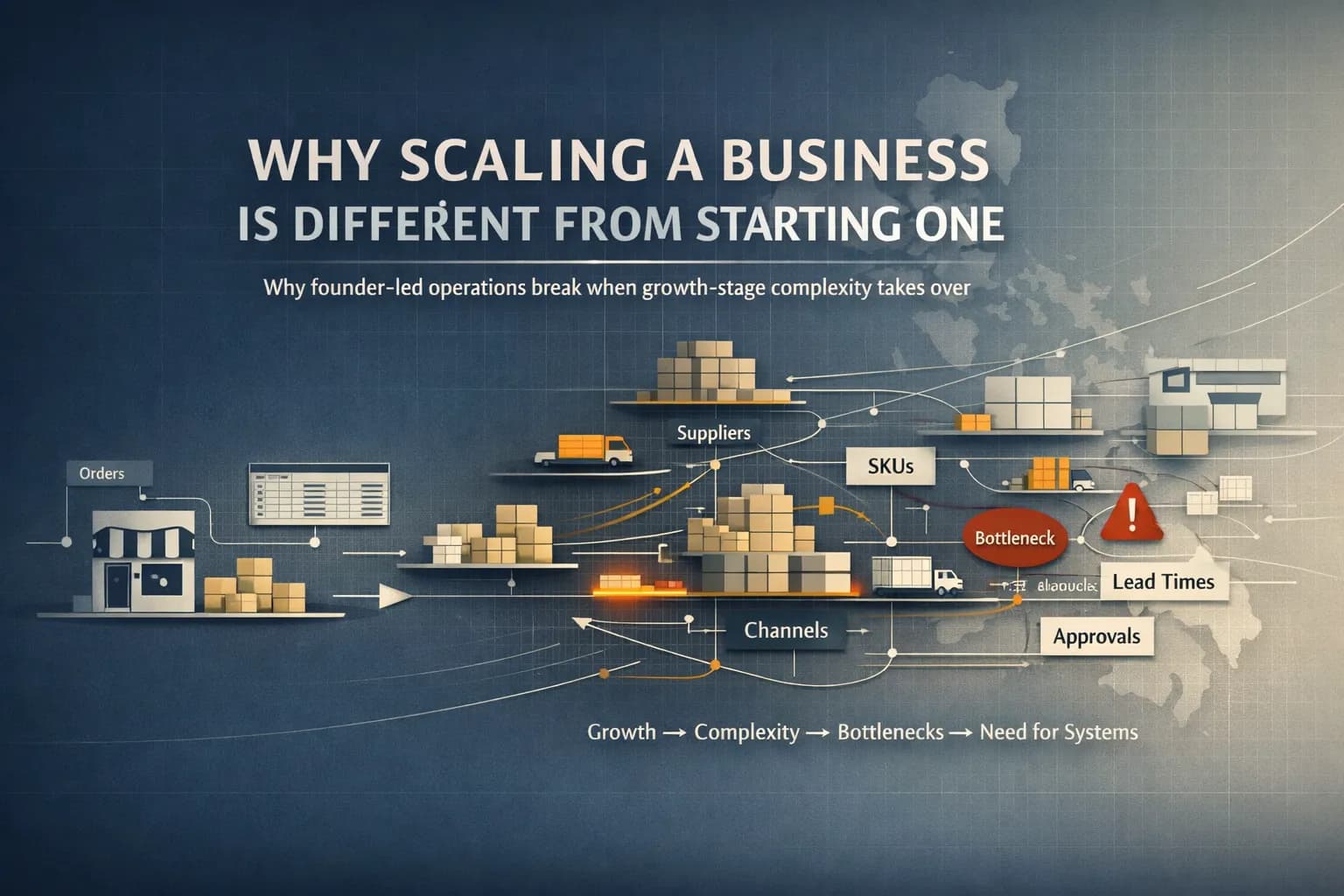
A useful lens here is Larry Greiner's well-known business growth model, which argues that the practices that help companies grow in one phase often create the crisis of the next. Growth magnifies coordination problems, communication gaps, and control issues. What once felt nimble starts becoming unstable.
That crisis rarely arrives as one dramatic event. In SMEs, it usually shows up as a hidden phase: the business is still "winning" commercially, but operations are already slipping. The signs are subtle at first because founders can still brute-force them with effort and urgency:
- You "fix" inventory errors by counting manually on weekends.
- You "fix" late supplier deliveries by expediting, pleading, or switching forwarders at the last minute.
- You "fix" unclear product data by asking someone to "check the sheet."
- You "fix" forecasting by ordering "what feels right" based on last month's sales.
The problem is that these fixes do not scale. They create operational debt\u2014and the interest rate on that debt rises with every new SKU, sales channel, supplier, and warehouse location.
A practical way to spot this phase early is to stop asking, "Are we growing?" and start asking harder operational questions:
Do you have one answer\u2014not three\u2014to "How many units do we actually have available to sell right now?"
Can you explain the difference between demand and sales, and quantify the gap?
If your top 20 SKUs suddenly doubled next month, would procurement and fulfillment stay stable\u2014or collapse into chaos?
If those questions feel uncomfortable, that is not a character flaw. It is a systems signal.
Operational Chaos in Scaling SMEs
The Spreadsheet Trap
Most SMEs start with spreadsheets because they are fast, familiar, and flexible. The trap is assuming that what is flexible at low volume stays safe at higher volume.
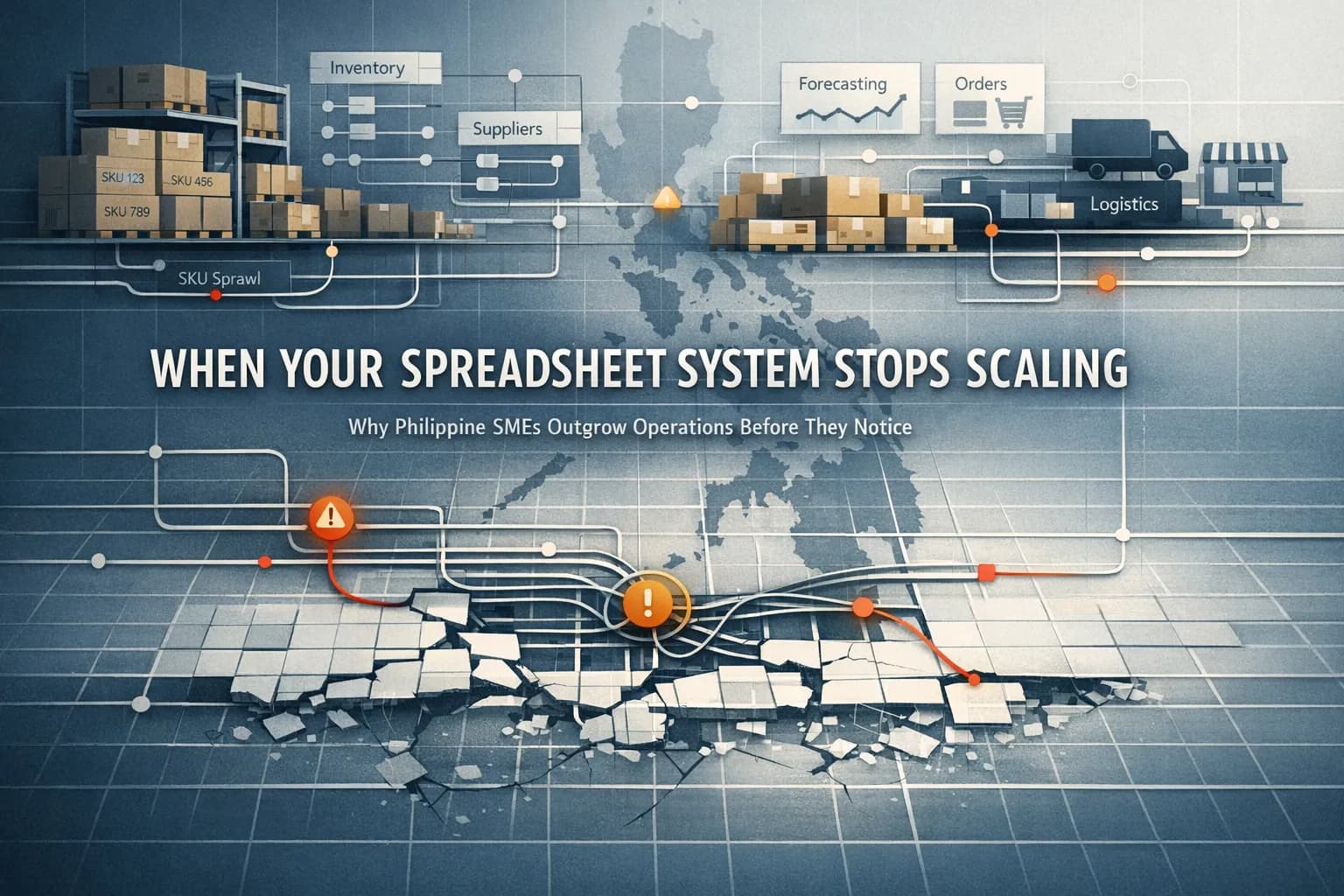
In reality, spreadsheet-heavy operations are far more fragile than they look. A widely cited study on operational spreadsheets found that **94% of audited spreadsheets contained errors**, which is exactly why spreadsheets become dangerous once they evolve from support tools into the business's real operating system.
The consequence is straightforward: once spreadsheets become the system of record for purchasing, inventory, pricing, and fulfillment, error becomes structural, not occasional.
It gets worse when spreadsheets become shadow systems\u2014critical tools that sit outside formal controls. The UK's National Cyber Security Centre guidance on shadow IT describes the broader risk clearly: when business-critical tools operate outside visibility and process discipline, control breaks down. In SME terms, the shadow system is usually not a server. It is the spreadsheet everyone depends on, distributed across chat threads, duplicated across devices, and edited without auditability.
How Chaos Spreads Before Owners Notice
Operational chaos is rarely one isolated problem. It is a chain reaction:
SKU sprawl \u2192 unclear inventory truth \u2192 reactive procurement \u2192 unreliable fulfillment
Here is what that looks like in practice.
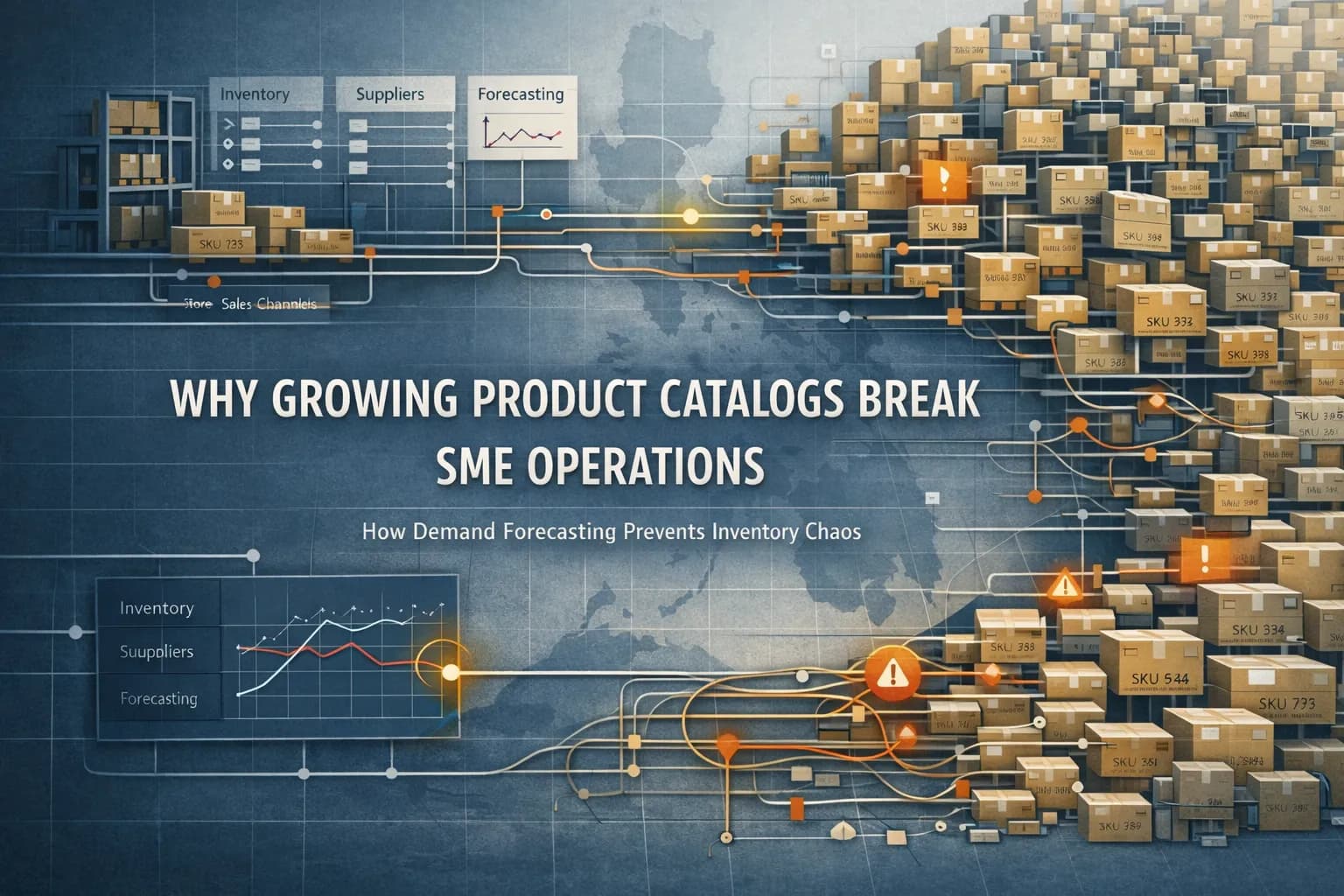
Poor SKU management becomes inventory blindness. When SKUs are not governed through consistent naming, identifiers, units of measure, bundles, variants, and barcode discipline, you get silent failures: duplicate SKUs, mismatched variants, multiple packaging units, and phantom stock that exists in a file but not in the warehouse. The operational consequences of this breakdown — stockouts, dead stock, and eroded margins — are covered in detail in our guide on inventory management for SMEs.
No forecasting turns demand into noise. Without structured forecasting, purchasing decisions tend to follow instincts, recent sales spikes, or supplier promotions. But supply chains punish guessing. The classic bullwhip effect research shows why: variability expands as distorted demand signals move upstream, causing instability, excess inventory, and stockouts even when end-customer demand is not especially volatile.
Unstructured procurement creates a bottleneck disguised as busyness. Procurement without standard workflows\u2014approval rules, reorder triggers, lead-time assumptions, inbound scheduling\u2014becomes memory plus urgency. "Place this PO now." "Follow up again." "Maybe air freight this batch." That feels responsive, but it is usually a sign the system cannot plan.
Supplier coordination becomes fragmented and costly. Once a business imports or distributes across regions, coordination failures get expensive fast because mistakes compound over longer lead times and across more handoffs.
Why This Problem Is Common in the Philippine SME Landscape
This pattern can happen anywhere SMEs scale quickly, but it is especially common in the Philippines because local growth often outpaces operational maturity.
E-commerce growth is moving faster than back-end capability. The Philippines' digital economy is expanding rapidly, and that creates pressure to add more SKUs, more channels, more promotions, and more geographic coverage before the operational backbone is ready. Businesses expanding into multiple sales channels often discover that each new channel multiplies the complexity their operational systems must handle. The e-Conomy SEA report also notes that digital transactions reached 57% of monthly retail payment volume and 59% of value by 2024, raising the speed and expectations of commerce.
Many MSMEs are digitally active but not operationally integrated. The DTI e-Commerce Philippines Roadmap 2022 shows that among digitalized MSMEs, 56% use basic tools, 34% have an online presence, and only 10% use advanced digital tools such as ERP, CRM, analytics, or automation. That is the heart of the problem: many firms have digitized selling, but not operations.
Logistics remains a structural constraint. The Philippines is not operating inside a low-friction logistics environment. The World Bank's 2023 Logistics Performance Index places the country at rank 43 with an LPI score of 3.3. Meanwhile, the OECD logistics review of the Philippines estimates average logistics cost-to-sales at 27.16%, with major regional differences\u201417.4% in Luzon versus 30.3% in Mindanao.
That matters because when the baseline cost of moving, storing, and replenishing goods is already high, operational mistakes become margin killers.
Congestion raises the cost of "fast." For businesses serving Metro Manila and surrounding areas, speed is expensive because the transport environment itself is unstable. A Philippine Review of Economics paper cites an annual social cost of around USD 20 billion tied to Metro Manila traffic. Separately, JICA references estimates of PHP 3.5 billion per day in transport costs in Metro Manila, projected to rise to PHP 5.4 billion per day by 2035 without intervention.
For SMEs, that translates into higher delivery variability, more safety stock pressure, more scheduling failures, and more customer service burden.
The Real Cost of Operational Chaos
Operational chaos is often blamed on people. Usually, it is a systems problem with financial consequences.
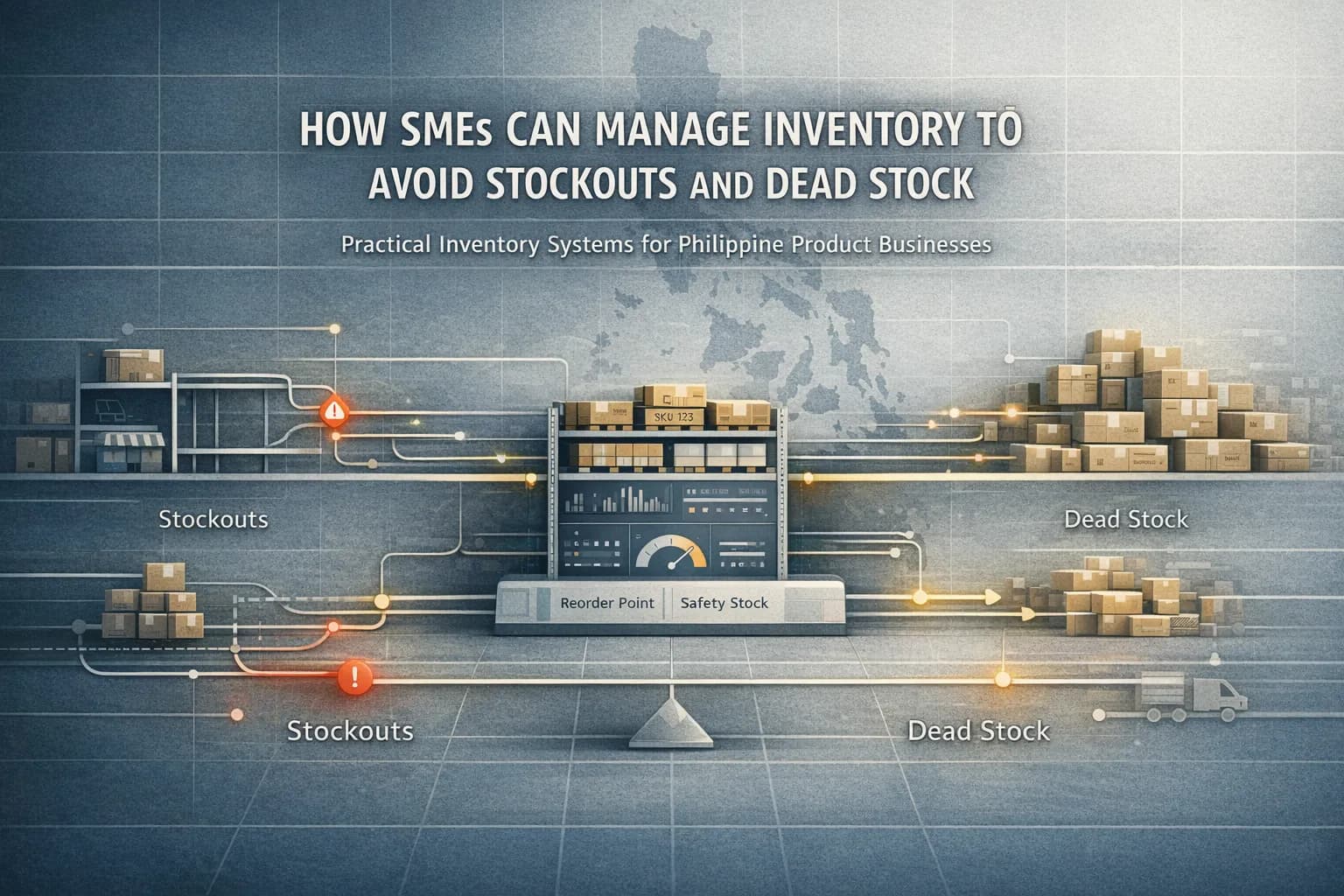
Stockouts and overstocks are twins, not opposites. When a business cannot forecast well and cannot trust its inventory records, it often suffers both. Fast movers go out of stock. Slow movers pile up. According to IHL Group's inventory distortion research, the worldwide cost of inventory distortion reached $1.7 trillion in 2024.
Overstock quietly drains cash flow. Inventory is not just stock. It is working capital sitting on shelves. Research on inventory holding cost often uses a rough benchmark of around 20% of item cost per year, which is why excess inventory is not a harmless buffer\u2014it is an ongoing cash leak. The Philippines-specific picture is even harsher: the OECD logistics assessment breaks out inventory carrying at 8.78% of sales within the broader logistics cost structure.
Fulfillment delays are often upstream failures disguised as warehouse problems. Many SMEs try to solve fulfillment by adding packers, riders, or couriers. That can help, but it does not fix broken planning. The DTI's logistics performance brief highlights reliability as the most important issue and points to planning-related KPIs like delivery-in-full-on-time, forecast accuracy, and cash conversion cycle.
Reactive ordering amplifies volatility. When upstream suppliers only see erratic order behavior instead of real demand patterns, volatility compounds. That is exactly how the bullwhip effect turns weak planning into expensive chaos.
Buffer stock without policy becomes expensive fear. Safety stock is useful. Guessing is not. The difference is whether the business has real rules around service levels, lead-time variability, reorder points, and risk tolerance.
What Structured Operations Actually Look Like
Structured operations are not bureaucracy for the sake of bureaucracy. They are what make growth predictable.
A single operational source of truth. This starts with an inventory and SKU foundation you can actually trust: one SKU master, consistent units of measure, controlled product data, and clear rules for bundles and variants.
Forecasting as a cadence. Forecasting should not be an occasional reaction. It should be a repeatable planning rhythm based on clean sales data, promotions, seasonality, and lead times.
Inventory policies tied to service and cash goals. Structured inventory planning is not about holding more stock. It is about holding the right stock in the right places with deliberate replenishment logic.
Procurement workflows that prevent emergencies. A real procurement system defines who can reorder, what triggers a reorder, how suppliers are managed, what lead times are assumed, and how inbound schedules are controlled.
Supplier coordination as a discipline. Lead times, fill rates, specification control, and escalation paths should not live in someone's head or in chat history.
Logistics planning based on Philippine realities. Businesses need planning assumptions that reflect actual congestion, regional delivery variability, and different logistics economics across Luzon, Visayas, and Mindanao.
How Operational Infrastructure Enables Scaling
When operations are structured properly, the effect is not abstract. It shows up in business performance:
- more stable inventory positions
- fewer surprise stockouts
- less overbuying
- better supplier reliability
- more predictable fulfillment
- tighter cash conversion
- stronger margins
- more confidence to expand SKUs, channels, or geographies
In other words, operational infrastructure does not just reduce chaos. It creates expansion capacity.
How Luxium Helps Businesses Build Operational Structure
This is where Luxium fits best\u2014not as "just a sourcing company," but as a partner that helps businesses build the operating structure underneath growth.
That includes:
- procurement systems that reduce reactive buying
- supply chain coordination across vendors and inbound timelines
- supplier networks that support consistency, not just availability
- distribution infrastructure that improves flow, not just movement
- operational design that supports forecasting, SKU planning, and inventory control
The point is not to add complexity. The point is to remove fragility.
A business should still own its commercial strategy\u2014products, pricing, channels, brand, customer growth. But the underlying operating system needs to be engineered well enough that growth becomes repeatable, not heroic.
Strategic Takeaway
If your operations are still being held together by spreadsheets, memory, and chat threads, your business is already paying a hidden tax.
The issue is not whether the business is "organized." The issue is whether the current operating model can handle more volume, more SKUs, more suppliers, and more complexity without breaking.
For many Philippine SMEs, stalled growth is not caused by lack of demand. It is caused by the fact that the business outgrew its operational system before anyone admitted it.
That is the real danger zone: when the company looks like it is scaling, but the system underneath it is already failing.
Sources
- Bangko Sentral ng Pilipinas \u2013 MSME data presentation
- Google, Temasek, and Bain \u2013 e-Conomy SEA 2025 Philippines snapshot
- Department of Trade and Industry \u2013 e-Commerce Philippines 2022 Roadmap
- OECD \u2013 Logistics sector in the Philippines
- World Bank \u2013 Logistics Performance Index 2023
- Powell, Baker, and Lawson \u2013 Errors in Operational Spreadsheets
- Lee, Padmanabhan, and Whang \u2013 Information Distortion in a Supply Chain: The Bullwhip Effect
- DTI \u2013 An Assessment of Logistics Performance of Manufacturing Firms in the Philippines
- IHL Group \u2013 Fixing Inventory Distortion
- UK National Cyber Security Centre \u2013 Shadow IT guidance
- Philippine Review of Economics \u2013 Metro Manila traffic cost study
- JICA \u2013 Metro Manila transport cost estimates