Choosing the Right Sales Channels for Philippine SMEs: Balancing Growth, Margins, and Operational Complexity
Introduction
Small and medium-sized enterprises (SMEs) form the backbone of the Philippine economy. They account for roughly 63% of employment and contribute about 36% of economic value added, according to reporting citing World Bank data.
At the same time, the country's digital commerce sector has expanded rapidly. The Philippine e-commerce market has grown around 400% over the past five years, making it one of the fastest-growing digital retail markets globally.
For founders, this growth creates both opportunity and risk.
Many SMEs expand into multiple sales channels — marketplaces, physical retail, wholesale distribution, and B2B accounts — without a clear structure. The result is often operational complexity, pricing conflicts, and shrinking margins.
Choosing the right sales channels is not simply a marketing decision. It directly affects pricing models, inventory management, logistics systems, and long-term profitability.
This article explains how Philippine SMEs should evaluate sales channels as they scale.
Why Sales Channel Strategy Matters
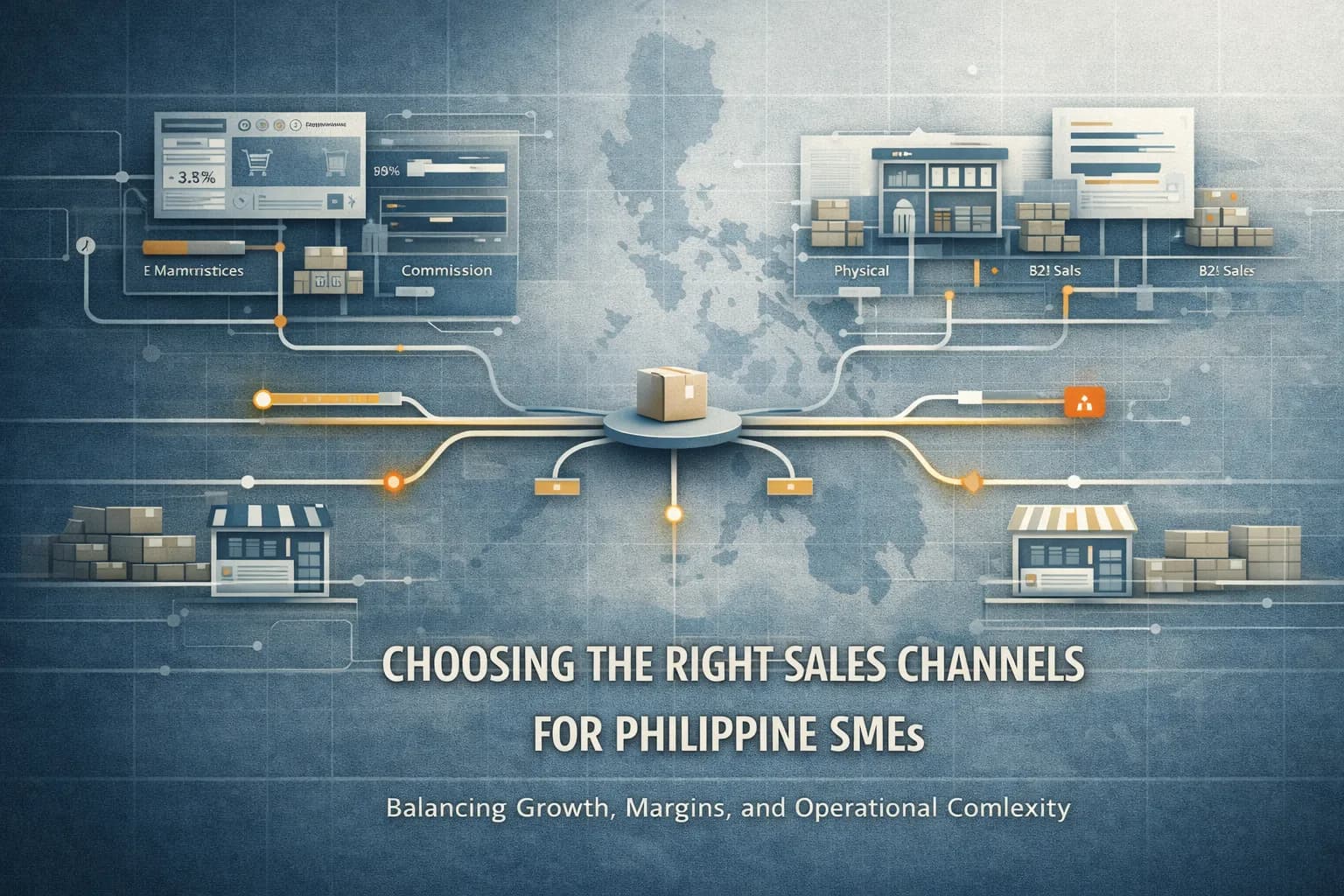
Sales channels determine how a product reaches customers. But they also shape the entire business model behind that product.
Three operational realities explain why channel strategy matters.
Revenue vs Operational Cost
Every new channel increases potential revenue, but it also introduces additional costs.
Online marketplaces provide built-in demand but charge commissions and platform fees. Physical stores offer visibility but require rent, staff, and inventory. Wholesale distribution increases reach but reduces margins.
Channel expansion should therefore be evaluated not just by sales growth, but by net profitability after operational costs.
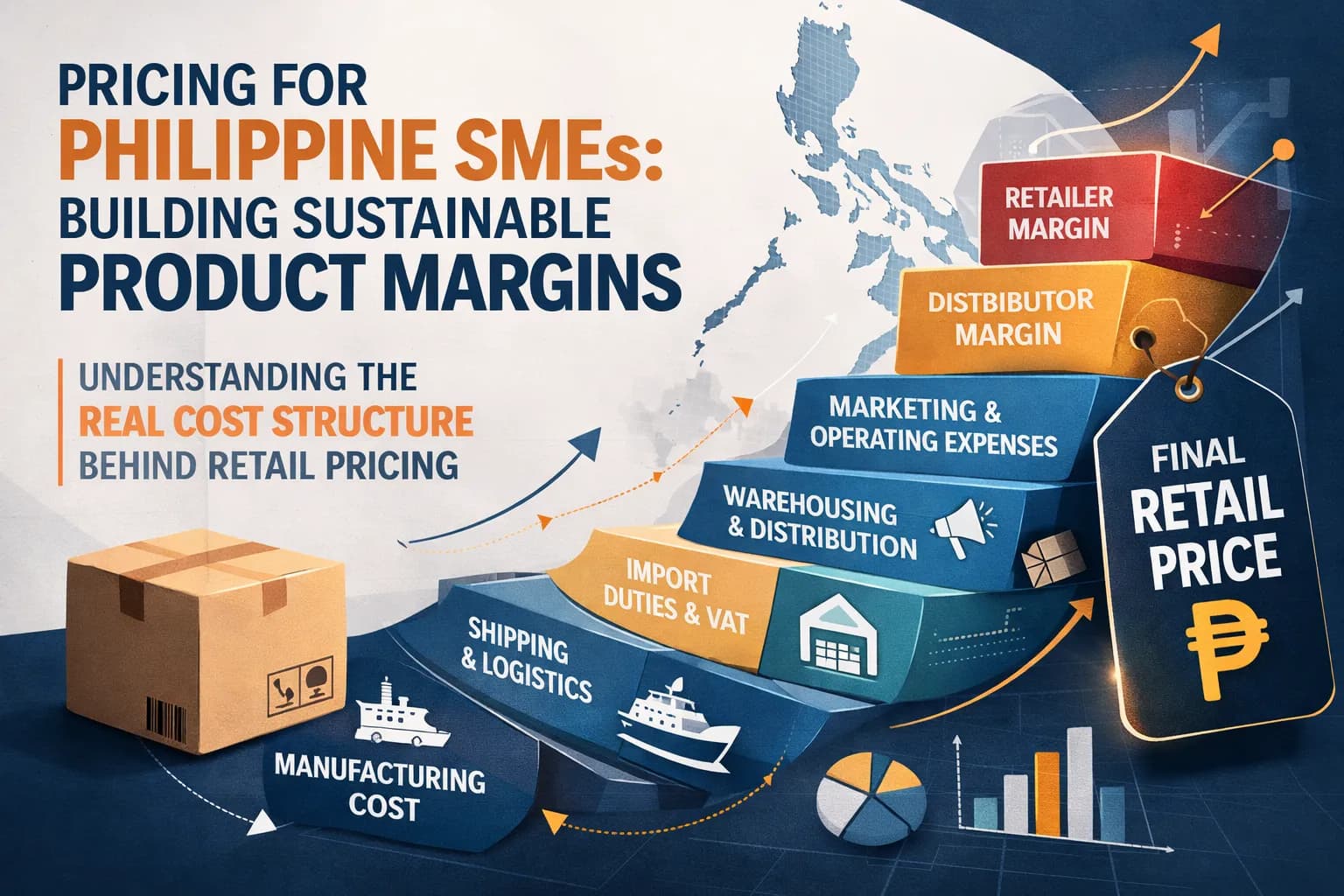
Pricing Structure and Margin Control
Each sales channel forces a different pricing structure.
Examples:
| Channel | Typical Pricing Dynamics |
|---|---|
| Marketplaces | Platform commissions reduce margins |
| Direct Website | Full margin but higher marketing costs |
| Retail Stores | Retail markup required |
| Distributors | Wholesale pricing discounts |
| B2B | Negotiated contract pricing |
If pricing is not carefully managed, companies can accidentally create channel conflict, where different channels compete against each other on price.
This often leads to margin erosion across the entire business.
A common example is when a distributor or reseller sells the same product online at a lower price than the brand's own store.
Logistics and Operational Complexity
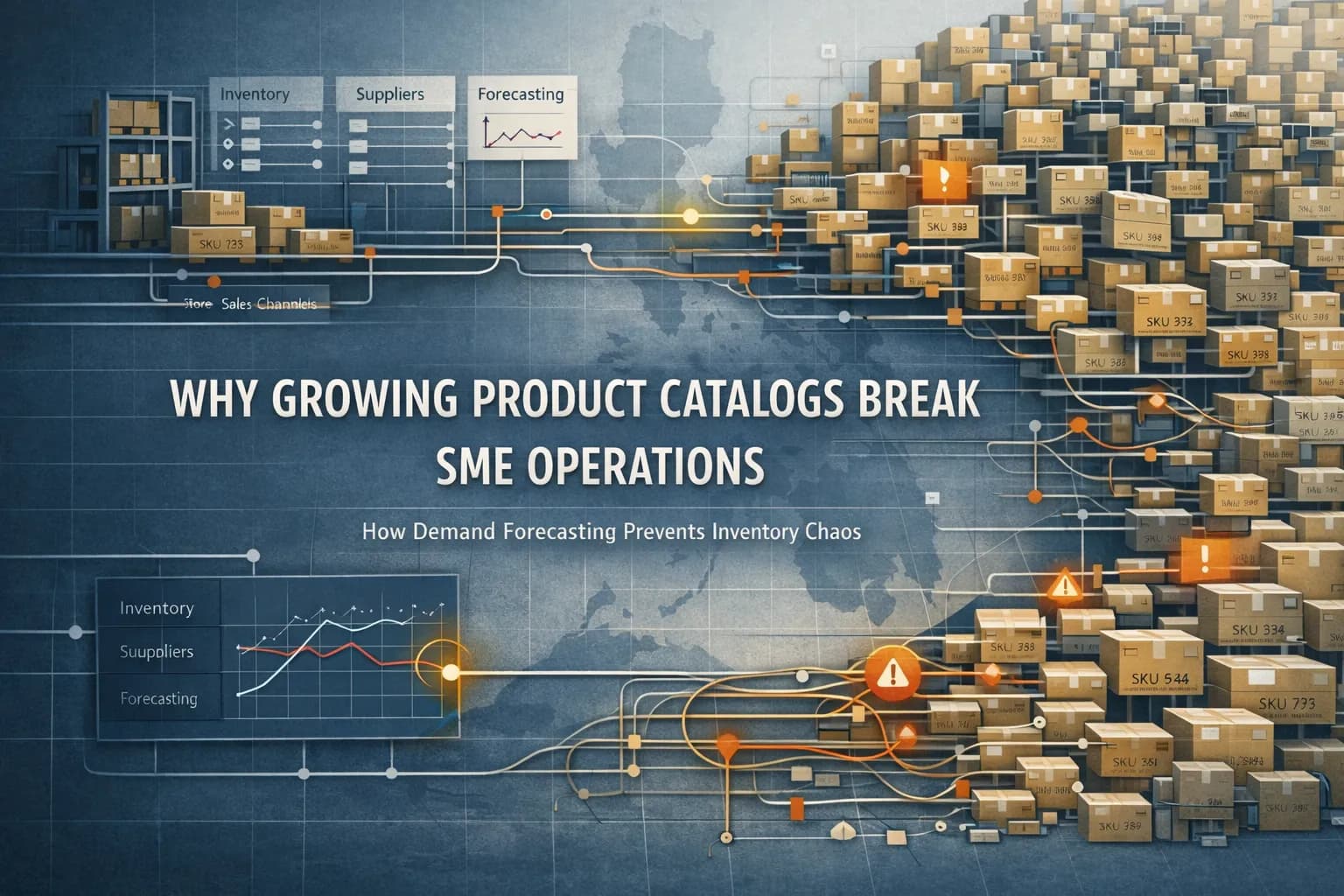
More channels mean more operational coordination.
Inventory must be allocated across:
- marketplaces
- physical stores
- distributor stock
- corporate orders
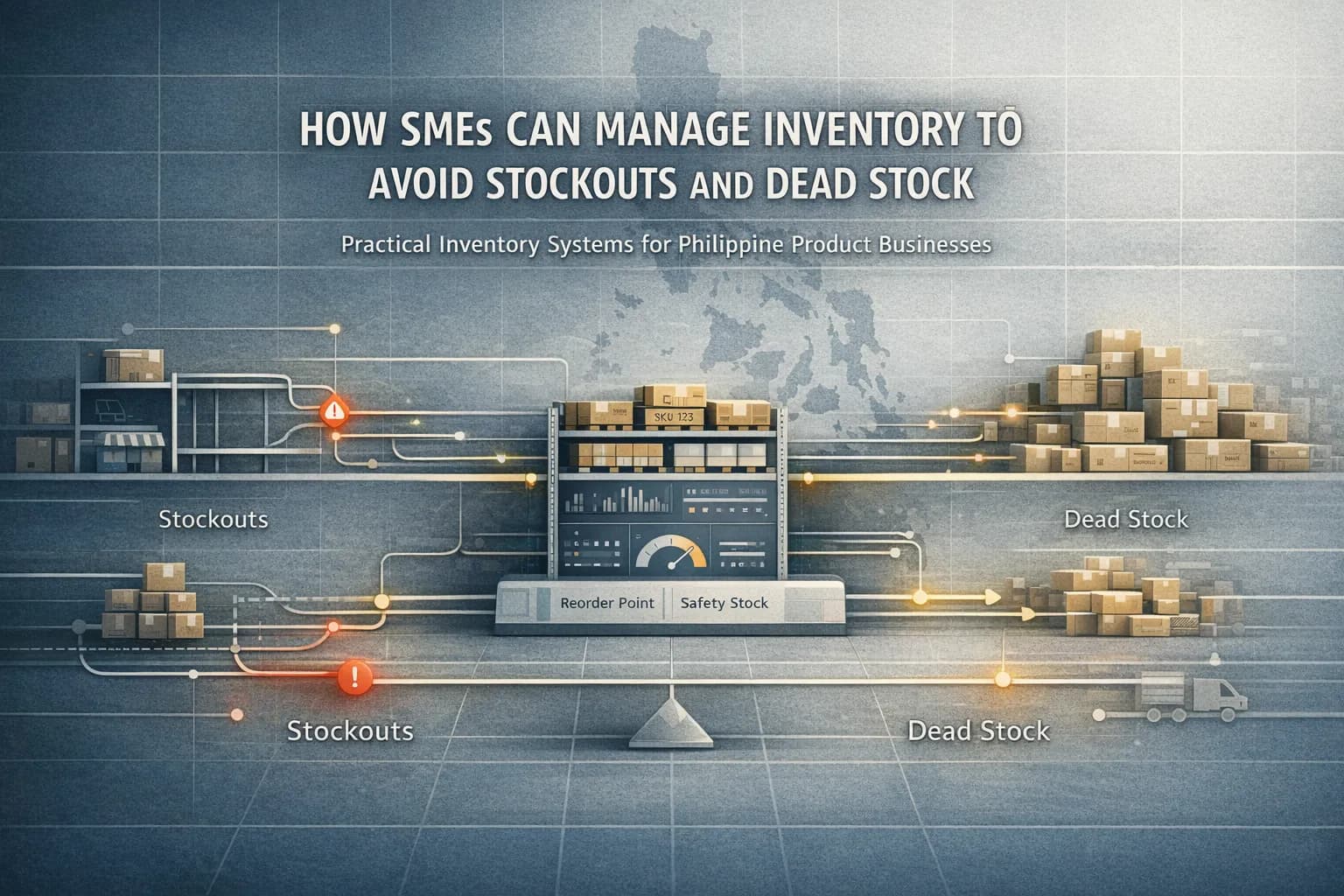
Without proper inventory systems, businesses risk stockouts or excess inventory. Expanding into multiple channels requires precise coordination across procurement, warehousing, and fulfillment — and that coordination depends on reliable demand forecasting.
Online Marketplaces (Shopee and Lazada)
Online marketplaces dominate digital commerce in the Philippines.
Between February and April 2024, Shopee captured about 51% of Philippine e-commerce traffic while Lazada held roughly 24%, making them the two largest platforms in the country.
For SMEs, marketplaces offer the fastest way to access customers.
Immediate Market Access
Marketplaces provide immediate exposure to millions of consumers without needing to build traffic independently.
This is particularly useful for:
- new brands
- importers testing product demand
- SMEs entering digital commerce
Built-In Logistics and Payments
Platforms typically provide integrated:
- payment systems
- courier partnerships
- dispute resolution
- seller dashboards
This reduces the infrastructure required for new businesses.
Platform Fees
Marketplace sales come with commissions and transaction fees.
Typical seller costs include:
- Lazada commission: roughly 1%\u20135% depending on category
- Shopee commission: roughly 7\u20139% depending on seller type
Transaction fees and promotional costs can further reduce margins.
Price Competition
Marketplaces create intense price transparency.
Consumers frequently compare identical products across multiple sellers, which encourages discounting and promotional campaigns.
This often pushes businesses toward lower pricing simply to remain competitive.
Margin Pressure
Between platform fees, advertising costs, and promotional discounts, many SMEs discover that marketplace sales generate high revenue but relatively thin profit margins.
Marketplaces should therefore be treated as high-volume channels rather than high-margin channels.
Direct-to-Consumer Websites
A company's own website represents the opposite approach.
Instead of selling through a platform, the business sells directly to customers through its own digital storefront.
Examples include Shopify, WooCommerce, or custom e-commerce websites.
Full Pricing Control
Unlike marketplaces, direct websites allow businesses to retain full control over pricing.
There are no commission fees beyond payment processing costs.
This can significantly increase margins on each sale.
Brand Positioning
Direct websites allow companies to control:
- product presentation
- storytelling
- customer experience
This is particularly important for premium or niche brands.
Customer Ownership
Selling through your own platform allows you to collect customer data, including email addresses and purchase history.
This enables:
- remarketing campaigns
- loyalty programs
- direct communication with customers
Marketplaces rarely allow sellers access to this data.
Traffic Acquisition
The biggest challenge for DTC websites is visibility.
Unlike marketplaces, websites do not come with built-in traffic.
Businesses must invest in:
- digital advertising
- search engine optimization
- social media marketing
Customer acquisition costs can therefore become significant.
Operational Requirements
Operating a direct online store requires additional capabilities:
- payment integration
- fraud prevention
- fulfillment systems
- customer service
For early-stage SMEs, this infrastructure can be difficult to maintain without external support.
Physical Retail
Despite the rise of e-commerce, physical retail still plays a major role in Philippine commerce.
Retail channels include:
- mall stores
- kiosks
- pop-up locations
- partner retailers
Operational Costs
Physical retail introduces substantial fixed costs.
Commercial rent in Metro Manila can range from approximately \u20B1700 to \u20B11,700 per square meter per month, depending on location.
Labor costs also add to overhead. Minimum wage in Metro Manila reached \u20B1695 per day in 2026, excluding benefits and employer contributions.
Additional retail expenses include:
- utilities
- store maintenance
- point-of-sale systems
- inventory losses
For many SMEs, fixed costs represent 40\u201360% of operating expenses in physical retail environments.
Advantages of Physical Retail
Physical retail provides benefits that digital channels cannot replicate:
- product experience and demonstrations
- brand visibility
- impulse purchases
- customer trust
Some companies also use retail stores as fulfillment points for online orders, enabling click-and-collect services. For brands considering their first physical retail presence, pop-up retail offers a lower-risk way to test demand before committing to permanent locations.
Distributors and Wholesale Channels
Distribution partners allow companies to expand market reach without building their own sales networks.
This is particularly important in the Philippines, where geographic fragmentation creates logistical challenges.
According to U.S. trade guidance on the Philippine market, using local agents or distributors can significantly improve market access and sales coverage.
Expanded Geographic Reach
Distributors often maintain relationships with retailers across multiple regions.
This allows brands to access markets that would otherwise require large sales teams.
Lower Operational Burden
Wholesale partners typically manage:
- local warehousing
- delivery logistics
- retailer relationships
This reduces operational complexity for manufacturers or importers.
Reduced Margins
Wholesale pricing typically requires discounts of 20\u201340% below retail prices.
This means distributors capture part of the value chain.
Channel Conflict
When companies sell directly while also using distributors, price conflicts can emerge.
Retailers may refuse to carry products if they are undercut by online prices.
Clear pricing policies are therefore essential.
B2B Sales Channels
Business-to-business sales represent a different type of sales channel entirely.
Instead of selling to consumers, companies sell to:
- corporate buyers
- institutions
- hospitality businesses
- government organizations
Larger Orders
B2B customers typically place larger orders than individual consumers.
This can significantly increase revenue per transaction.
Negotiated Pricing
Prices are usually negotiated based on volume and contract terms.
Margins per unit may be lower, but total revenue per sale is higher.
Longer Sales Cycles
B2B deals often involve procurement processes, approvals, and documentation.
Sales cycles may take weeks or months.
Growth Opportunity
B2B digital commerce remains relatively underdeveloped in the Philippines.
Estimates suggest that only around 15% of business transactions occur through B2B e-commerce platforms, although the sector is growing rapidly.
This represents a potential growth area for SMEs with the operational capacity to serve business clients.
When Businesses Should Expand Sales Channels
Expanding channels too early can strain operations.
Several signals suggest a business may be ready to expand.
Stable Demand
Businesses should first establish consistent demand in their existing channel before adding new ones.
A common benchmark is 6\u201312 months of stable sales performance.
Reliable Inventory Systems
Accurate inventory tracking is essential before expanding channels.
Multi-channel selling without synchronized inventory systems often leads to stockouts or overstocking. Our guide on inventory management for SMEs covers the frameworks that help prevent both.
Operational Capacity
Businesses should ensure they can handle higher order volumes.
This includes:
- supplier capacity
- warehouse space
- logistics partners
Expanding channels without operational capacity often results in delayed deliveries and dissatisfied customers.
Operational Considerations When Expanding Channels
Sales channel expansion is fundamentally an operational challenge.
Several systems must scale alongside revenue.
Inventory Planning
Each channel may require separate inventory allocation.
Examples:
- marketplace fulfillment centers
- retail store stock
- distributor inventory
- corporate orders
Multichannel inventory management systems are essential for maintaining accurate stock levels.
Pricing Strategy
Pricing should account for channel-specific costs.
Example structure:
| Channel | Typical Margin Impact |
|---|---|
| Website | Highest margins |
| Marketplaces | Moderate margins after fees |
| Retail | Lower margins due to overhead |
| Wholesale | Lowest per-unit margin |
Maintaining consistent pricing across channels helps prevent internal competition.
Logistics Coordination
Different channels often require different delivery models:
- courier shipments for e-commerce
- pallet shipments for B2B
- bulk transport for distributors
As companies expand, logistics coordination becomes a critical capability.
Supply Chain Capacity
Channel expansion increases total sales volume.
Businesses must ensure suppliers can meet higher demand.
This often requires:
- secondary suppliers
- buffer inventory
- longer procurement planning cycles
Companies experienced in sourcing and distribution frequently prioritize supplier diversification to reduce supply chain risk.
Conclusion
Choosing the right sales channels is one of the most important strategic decisions facing growing SMEs.
Each channel offers advantages, but also introduces operational trade-offs.
Key lessons include:
- Marketplaces provide reach but compress margins.
- Direct websites offer control but require marketing investment.
- Retail stores build brand presence but add fixed costs.
- Distributors expand reach but reduce pricing control.
- B2B sales generate large orders but involve longer sales cycles.
Successful SMEs rarely expand everywhere at once.
Instead, they scale channels gradually, ensuring that inventory systems, logistics networks, and pricing structures can support growth.
For businesses involved in importing, distribution, and retail, sales channel strategy ultimately becomes a supply chain decision as much as a marketing one.
Companies that understand both sides of this equation tend to scale more sustainably. Luxium's distribution services help businesses build the logistics infrastructure that multi-channel selling demands.
Sources
- BusinessWorld / World Bank SME statistics
- Philstar reporting on Philippine e-commerce growth
- Anchanto Philippines E-commerce Industry Guide
- BigSeller Lazada Fee Guide
- SiteGiant Shopee Seller Fees Guide
- Triple i Consulting Philippine Business Cost Guide
- U.S. Trade Guide \u2013 Philippines Distribution Channels
- CloudEcommerce Philippines B2B Market Report