How SMEs Can Manage Inventory to Avoid Stockouts and Dead Stock
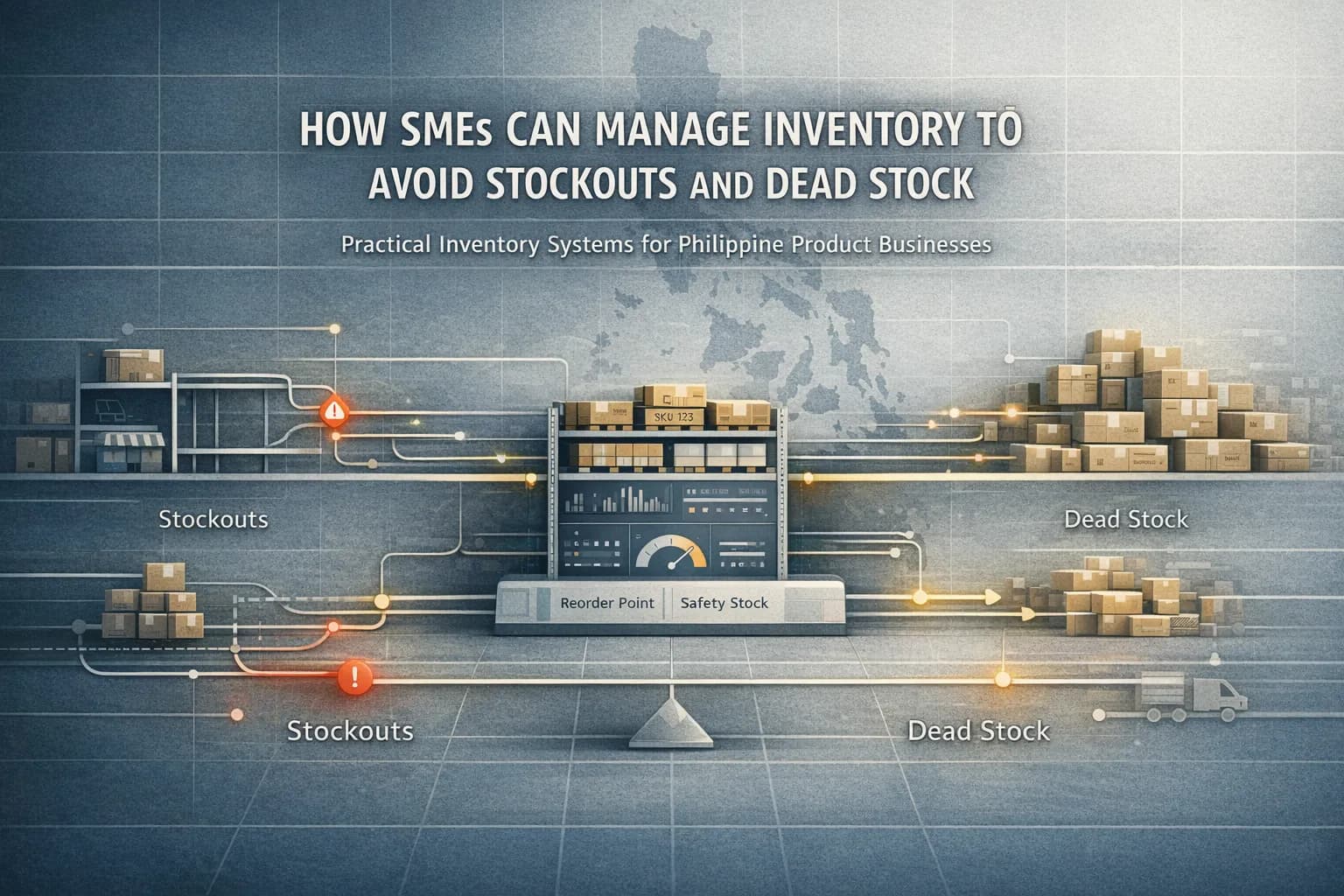
Practical Inventory Systems for Philippine Retailers, Importers, and Product-Based Businesses
For most product-based businesses, inventory sits in an uncomfortable spot: it is both the engine and the liability.
Retailers, distributors, and importers need inventory to make money. That much is obvious. But the same inventory can quietly bleed a company dry if nobody is watching it closely. Too much stock locks up working capital. Too little means turning customers away. And for small and medium-sized businesses trying to grow, the margin for error on both sides is thinner than most founders realize.
In the Philippines, where SMEs account for over 99% of all businesses, getting inventory right is not an academic exercise — it is a survival skill. Most of these companies operate with limited forecasting tools, informal purchasing habits, and product catalogs that expand faster than the systems tracking them.
As businesses grow, inventory decisions start touching everything:
- cashflow stability
- operational efficiency
- supply chain resilience
- profitability
This article walks through the operational principles that help SMEs manage inventory effectively — avoiding stockouts on one end and dead stock on the other.
Why Inventory Problems Keep Showing Up in SMEs
Inventory problems rarely come from a single bad decision. They tend to emerge from patterns that develop gradually as a business scales — patterns that feel reasonable in the moment but compound into real trouble over time.
Three factors show up again and again.
1. Product Catalogs That Grow Faster Than the Systems Behind Them
Growth creates a natural temptation to add more products. Retailers bring in new models. Importers source additional variants. Distributors widen their catalogs to serve more clients.
The issue is that every new product creates another SKU — one more item that has to be forecasted, purchased, stored, tracked, and eventually sold. When demand per SKU drops too low, inventory starts fragmenting across dozens or hundreds of products that move slowly or stop moving entirely.
Research on inventory planning consistently shows that a large share of SKUs in many businesses sell infrequently and eventually become dead stock. This is not a failure of ambition. It is a natural consequence of adding products without the discipline to remove them.
2. Forecasting by Feel Instead of by Data
Most SMEs do not use formal forecasting models. Purchasing decisions happen based on recent sales, supplier promotions, gut feeling, or some combination of the three.
This reactive approach creates inconsistent ordering. Businesses over-order when demand temporarily spikes, then under-order when they underestimate the next wave. Both outcomes cause problems — overstocks here, stockouts there, and plenty of firefighting in between. Our guide on demand forecasting for Philippine SMEs covers how to move from gut-feel purchasing to structured planning.
Operational studies of Philippine manufacturing and trading SMEs have found that producing or purchasing inventory "just in case" — rather than aligning orders with actual demand — often locks up 20–30% more working capital than necessary.
3. Purchasing Under Pressure
When procurement decisions happen reactively — scrambling to cover a stockout, jumping on a supplier discount, placing a rush order because something ran out — inventory planning becomes erratic.
Reactive purchasing tends to create:
- excess inventory from panic bulk orders
- stockouts caused by delayed reordering
- persistent mismatches between what is on the shelf and what customers actually want
Over time, these patterns compound. And the frustrating part is that they often look like urgency and responsiveness from the inside, even as they are quietly eroding margins. When purchasing pressure also involves cashflow constraints, the compounding effect becomes even more dangerous.
Inventory Turnover: The Number That Tells You How Well Your Inventory Is Working
If there is one metric that product-based businesses should understand early, it is inventory turnover.
Inventory turnover measures how quickly a company sells through its stock and replaces it. The basic formula is straightforward:
Inventory Turnover = Cost of Goods Sold ÷ Average Inventory
A higher number means products are moving. A lower number means inventory is sitting.
(Investopedia — Inventory Turnover Ratio)
What This Looks Like in Practice
Take a retailer with ₱5,000,000 in annual sales and ₱1,000,000 in average inventory.
5,000,000 ÷ 1,000,000 = 5 turns per year
The business sells through its entire inventory five times annually. If the same company can push turnover to 7 turns, it supports the same sales volume with significantly less inventory — freeing up cash that can go toward marketing, expansion, new products, or simply a more comfortable bank balance.
Why Low Turnover Should Worry You
Low turnover usually signals one or more of the following:
- purchasing too aggressively
- carrying products with weak demand
- poor product selection in the first place
Slow-moving inventory also increases carrying costs — warehouse space, insurance, handling labor, financing. These costs are easy to ignore because they do not arrive as a single invoice, but they add up quietly.
Dead stock is particularly expensive because a company only recovers its inventory investment when products actually sell. Until then, that capital is stuck on a shelf, doing nothing.
Dead Stock: What Happens When Forecasting Gets It Wrong
Dead stock is inventory that is unlikely to sell at any reasonable price.
It accumulates when businesses overestimate demand, order too aggressively, or simply maintain too many SKUs without reviewing what is actually moving. NetSuite defines dead stock as inventory that remains unsold for extended periods with little chance of selling at normal prices.
Every business has some dead stock. The question is whether it is a manageable percentage or a growing problem.
The Real Cost of Dead Stock
Cashflow. Inventory is money that has already been spent. If the product does not sell, the business cannot recover its investment. That capital sits on warehouse shelves instead of circulating through the business. Inventory carrying costs alone can represent 20–30% of inventory value annually when you include storage, insurance, and financing.
Storage and operations. Unsold products consume warehouse space, staff time for counting and handling, and management attention — all without generating a single peso in return.
Obsolescence. The longer inventory sits, the higher the risk it becomes unsellable entirely. Technology products, seasonal goods, and trend-driven items are especially vulnerable. When obsolescence hits, businesses either sell at a steep loss or write the inventory off completely.
Safety Stock: Building a Buffer Without Hoarding
No demand forecast is perfect. Suppliers get delayed. Logistics break down. A marketing campaign outperforms expectations.
This is why businesses maintain safety stock — extra inventory that absorbs disruptions from demand variability and supplier lead time uncertainty. Safety stock exists specifically to prevent stockouts when reality does not match the plan.
Why This Matters More Than Most SMEs Realize
Without safety stock, even minor supply disruptions trigger stockouts. And stockouts are expensive — not just in lost sales, but in lost customers. Research on global retail supply chains estimates that stockouts result in hundreds of billions of dollars in lost sales annually worldwide.
For SMEs, the damage is often worse on a per-incident basis because customers in competitive markets switch to alternatives quickly and do not always come back.
A Simple Safety Stock Formula
A commonly used calculation:
Safety Stock = (Maximum Daily Sales × Maximum Lead Time) − (Average Daily Sales × Average Lead Time)
This ensures the business carries enough inventory to cover both demand spikes and supplier delays — without building a warehouse full of excess stock that never moves.
The key word is "calibrated." Safety stock should be a calculated buffer, not a pile of inventory accumulated out of anxiety.
Reorder Points: Taking the Guesswork Out of Replenishment
Knowing when to reorder is just as important as knowing how much to carry.
A reorder point is the inventory level that triggers a new purchase order. The formula:
Reorder Point = (Average Daily Sales × Lead Time) + Safety Stock
(NetSuite — Safety Stock and Reorder Points)
Example
A product that sells 10 units per day, with a 15-day supplier lead time and 50 units of safety stock:
Reorder Point = (10 × 15) + 50 = 200 units
When inventory drops to 200 units, the business places a new order. Replenishment arrives before stock hits zero. No panic. No rush freight. No disappointed customers.
Simple systems like this prevent a surprising number of operational headaches.
SKU Planning: The Discipline Most Growing Businesses Avoid
As businesses expand, product complexity becomes one of the largest — and least visible — operational challenges.
Each SKU introduces purchasing decisions, storage requirements, forecasting needs, and tracking overhead. If SKU counts grow without regular pruning, operational complexity scales much faster than revenue.
SKU Rationalization
SKU rationalization is the process of reviewing product performance and cutting items that are not earning their place in the catalog.
This helps businesses:
- concentrate resources on high-performing products
- reduce inventory complexity and carrying costs
- free working capital trapped in slow-moving items
It is not glamorous work. But the companies that do it regularly tend to run leaner and grow faster than those that avoid it.
The 80/20 Reality
In many product-based businesses, roughly 20% of SKUs generate 80% of revenue. The remaining 80% of products contribute relatively little — but they still consume purchasing attention, warehouse space, and working capital.
Identifying and eliminating the bottom performers is one of the fastest ways to improve turnover and reduce dead stock risk.
Operational Lessons That Show Up Again and Again
As SMEs mature, inventory management inevitably becomes more systematic. The businesses that handle this transition well tend to follow a few consistent principles.
Build Inventory Visibility Before You Need It
Track incoming inventory, sales velocity, current stock levels, and supplier lead times — even if you start with a basic spreadsheet. Without visibility, you cannot manage turnover or anticipate problems. By the time you realize you need a system, you are usually already behind. Our article on when spreadsheet systems stop scaling explores this transition point in depth.
Review Inventory on a Regular Cadence
Monthly inventory reviews help catch slow-moving SKUs, emerging stockouts, and purchasing patterns that are drifting off course. The review does not need to be complex. It needs to be consistent.
Align Procurement With What Is Actually Selling
Sales promotions, marketing campaigns, and seasonal shifts should feed directly into procurement planning. Inventory systems should reflect how products actually move — not how the team assumes they will move.
Invest in Supplier Reliability
Supplier relationships have a direct impact on how much safety stock you need. Businesses with long import lead times or inconsistent suppliers require larger buffers, which means more capital tied up in inventory.
In the Philippines, this is not a minor consideration. Logistics costs and supply chain constraints remain significant operational challenges, with logistics expenses sometimes reaching up to 27% of product cost in certain supply chains. Reliable sourcing is not just a procurement preference — it is an inventory planning input.
Conclusion
Inventory management is one of those disciplines that rarely gets attention when things are going well. Nobody celebrates a warehouse that is running smoothly. But when inventory goes wrong — stockouts frustrating customers, dead stock eating cash, warehouses overflowing with products nobody is buying — it becomes the most urgent problem in the business overnight.
The good news is that SMEs do not need enterprise-grade systems to get inventory right. Simple frameworks, applied consistently, make a meaningful difference:
- Track inventory turnover and treat it as a core business metric
- Monitor slow-moving inventory and clear it before it becomes dead stock
- Maintain appropriate safety stock buffers based on real demand and lead time data
- Implement reorder point systems so replenishment happens automatically, not reactively
- Conduct periodic SKU rationalization to keep the product catalog focused
Inventory is not just a purchasing decision. It is a strategic operating system that influences cashflow, profitability, and how confidently a business can grow.
The companies that treat it as a managed system — rather than something that just happens between supplier orders and customer sales — are consistently the ones that scale without breaking. For businesses that need structured sourcing and supplier coordination, Luxium's procurement services can help build the operational foundation that effective inventory management requires.
Sources
- Department of Trade and Industry — Philippine MSME Statistics
- Investopedia — Inventory Turnover Ratio
- NetSuite — Dead Stock Guide
- NetSuite — Safety Stock and Reorder Point
- Acctivate — SKU Rationalization
- TraceData Research — Philippine Logistics and Warehousing Market
- Wasawas — Why Philippine Manufacturing SMEs Lose 20–30% Profit to Waste