Philippine Labor Laws for Business Owners: A Practical Guide to Hiring, Payroll, and Compliance
Introduction
Hiring employees in the Philippines introduces legal and operational responsibilities that many small businesses underestimate. Labor regulations govern wages, working hours, employment contracts, benefits, payroll deductions, and employee protections. Non-compliance can result in penalties, labor disputes, and operational disruption.
For founders and SME operators, labor compliance is not simply a legal obligation — it is part of building a stable operating system for the business. Structured workforce management ensures predictable payroll costs, protects the company from regulatory exposure, and creates a more sustainable employment environment.
This guide explains the core labor laws and HR compliance requirements businesses must understand when hiring employees in the Philippines. It also examines the internal systems companies need as their workforce grows.
Overview of Philippine Labor Laws
Philippine employment regulations are primarily governed by the Labor Code of the Philippines (Presidential Decree No. 442) and enforced by the Department of Labor and Employment (DOLE).
These regulations establish minimum standards for employment conditions, employee rights, and employer responsibilities.
Key areas covered include:
- Minimum wage regulations
- Working hours and overtime compensation
- Leave entitlements
- Termination rules and employee protections
- Mandatory government contributions
- Occupational safety and health requirements
DOLE functions as the central regulatory body responsible for enforcing labor standards, conducting workplace inspections, and resolving labor disputes.
Employers operating in the Philippines must comply with both national labor regulations and regional wage orders issued by Regional Tripartite Wages and Productivity Boards.
Minimum wage levels differ by region. For example, Metro Manila wage orders are periodically adjusted by the NCR wage board under DOLE supervision.
More details on wage regulation can be found through the DOLE wage resources.
Basic Requirements When Hiring Employees
Once a business hires staff, several legal obligations immediately apply.
Employment Contracts
Although verbal employment agreements can technically exist, written employment contracts are strongly recommended for clarity and legal protection.
Employment contracts should specify:
- Job title and responsibilities
- Salary and payment schedule
- Working hours
- Leave benefits
- Probationary period terms
- Termination conditions
Under the Labor Code, probationary employment generally cannot exceed six months, after which employees may be regularized if they meet performance standards.
Failure to define expectations clearly during probation often leads to labor disputes.
Further guidance can be found in the Labor Code provisions published by DOLE.
Minimum Wage Compliance
Employers must comply with minimum wage requirements set by the Regional Tripartite Wages and Productivity Boards.
As of recent wage adjustments, minimum wages vary depending on region and sector.
Employers who pay below the mandated minimum wage may face penalties and back-pay obligations.
Official wage orders are published through the National Wages and Productivity Commission.
Working Hours and Overtime
The standard work schedule under Philippine labor law is 8 hours per day and 48 hours per week.
Any work beyond eight hours qualifies as overtime and must be compensated with an additional premium.
Typical overtime premium rules include:
- Overtime on regular workday: +25% hourly rate
- Overtime on rest day: +30% hourly rate
- Work on regular holiday: up to 200% daily wage
These standards are outlined in the Labor Code and summarized in DOLE labor advisories.
Statutory Benefits
Employers must provide several mandatory benefits, including:
- Service Incentive Leave (SIL) — minimum 5 days annually for eligible employees
- Holiday pay
- 13th month pay
The 13th month pay requirement applies to rank-and-file employees and must be paid by December 24 each year. It is equivalent to 1/12 of the employee's total basic salary earned during the year.
The policy was established under Presidential Decree No. 851.
Official guidance: DOLE — 13th Month Pay Guidelines
Mandatory Government Contributions
Employers must also register employees with government social protection programs and remit regular contributions. Failure to remit these contributions can result in penalties and legal liability.
Social Security System (SSS)
SSS provides social insurance benefits including:
- Retirement pensions
- Disability benefits
- Sickness benefits
- Maternity benefits
Both employers and employees contribute monthly. Contribution rates are based on a salary credit schedule. Recent adjustments increased the SSS contribution rate to 14% of the employee's monthly salary credit, shared between employer and employee.
Official contribution schedules are published by SSS.
PhilHealth
PhilHealth provides national health insurance coverage for employees.
Contributions are calculated as a percentage of monthly salary, shared between employer and employee.
PhilHealth contribution schedules and policies can be found at PhilHealth.
Pag-IBIG Fund
The Pag-IBIG Fund provides housing loan programs and savings benefits.
Both employer and employee contribute monthly, typically 1–2% of monthly compensation depending on salary level.
Official guidelines are available at Pag-IBIG Fund.
Core HR Systems Businesses Need
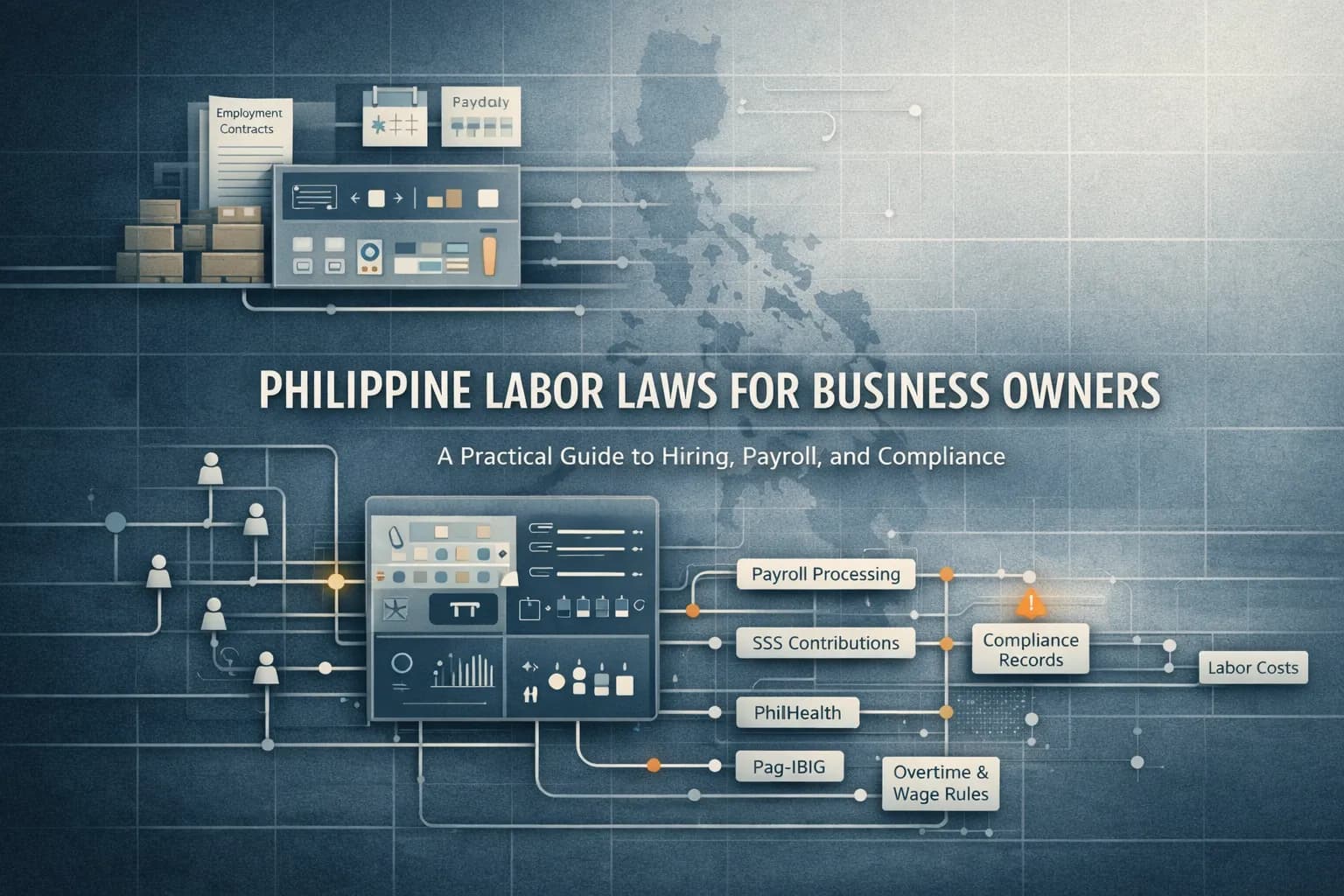
As businesses scale, workforce management becomes operationally complex. Companies must maintain reliable HR infrastructure to ensure regulatory compliance and operational efficiency.
Employee Records Management
Employers must maintain documentation including:
- Employment contracts
- Payroll records
- Tax documents
- Attendance records
- Leave records
These records are required for labor inspections and dispute resolution. DOLE regulations require employers to maintain accurate employment records.
Payroll Processing
Payroll management includes:
- Salary calculations
- Statutory contribution deductions
- Tax withholding
- Overtime computations
- Benefit payments
Incorrect payroll processing can lead to labor complaints, financial penalties, or compliance audits. Manual payroll processes often become unsustainable once employee counts grow.
Attendance and Timekeeping
Accurate timekeeping systems help businesses manage:
- Overtime calculations
- Rest day compensation
- Holiday pay
- Leave tracking
Many SMEs initially rely on spreadsheets or manual logs, but these methods frequently create discrepancies. Digital timekeeping systems help reduce disputes and improve payroll accuracy.
Compliance Documentation
Businesses must maintain organized records for:
- Government remittance filings
- Employee benefit contributions
- Tax documentation
- Labor inspection requirements
Structured documentation reduces operational risk during compliance audits.
Common HR Mistakes SMEs Make
Many early-stage businesses make avoidable HR mistakes that later create legal exposure.
Informal Employment Agreements
Hiring employees without formal contracts often leads to disputes over compensation, responsibilities, or termination. Clear documentation protects both the employer and the employee.
Misclassifying Employees and Contractors
Some businesses classify workers as independent contractors to avoid payroll obligations. However, Philippine labor law uses control tests to determine employment relationships. If a worker functions as an employee, misclassification can lead to back-pay liabilities and labor complaints.
Payroll Calculation Errors
Manual payroll calculations frequently lead to mistakes in:
- Overtime pay
- Holiday pay
- Statutory contributions
- Tax withholding
These errors accumulate over time and may result in regulatory penalties. As businesses grow, relying on spreadsheet-based systems for payroll calculations becomes increasingly risky.
Missed Compliance Deadlines
Government contribution remittances must be submitted on time. Late remittances for SSS, PhilHealth, or Pag-IBIG may incur penalties and interest charges.
Why HR Infrastructure Matters as Businesses Scale
As companies expand, workforce management becomes a structured operational system rather than an administrative task. Well-designed HR systems improve several core business outcomes.
Operational Stability
Clear payroll processes ensure predictable labor costs and reduce financial uncertainty.
Legal Compliance
Consistent documentation and automated contribution tracking reduce regulatory exposure.
Employee Retention
Employees expect transparent payroll processes and reliable benefits administration. Poor HR management often leads to turnover and workplace dissatisfaction.
Organizational Efficiency
Centralized HR systems improve visibility across the organization, allowing leadership to manage workforce capacity more effectively.
Workforce Systems and Payroll Infrastructure
Many growing companies eventually adopt dedicated payroll and HR infrastructure to manage these requirements. Structured workforce systems help automate:
- Payroll computation
- Statutory contribution calculations
- Employee record management
- Compliance documentation
Operational platforms that integrate payroll, workforce records, and compliance tracking allow businesses to manage HR responsibilities more reliably.
For companies expanding their workforce, implementing structured payroll infrastructure early can prevent administrative bottlenecks and regulatory risk.
Luxium works with businesses to help establish these operational systems — including tools like the Payroll App for structured payroll processing, workforce record management, and HR infrastructure that aligns with Philippine compliance requirements.
The goal is not simply automation, but building a reliable operational framework that allows companies to focus on growth while maintaining regulatory discipline.
Conclusion
Hiring employees in the Philippines requires more than offering a salary. Businesses must comply with labor regulations, maintain payroll accuracy, and manage statutory contributions.
Entrepreneurs who treat workforce management as an operational system — rather than an administrative afterthought — build more stable organizations.
Key takeaways:
- Philippine labor regulations set minimum standards for employment conditions.
- Employers must comply with wage orders, overtime rules, and mandatory benefits.
- Government contributions to SSS, PhilHealth, and Pag-IBIG are legally required.
- HR infrastructure becomes essential as teams grow.
- Structured payroll and workforce systems reduce compliance risks and operational friction.
For growing businesses, establishing proper HR infrastructure early helps avoid costly corrections later.
Sources
- Department of Labor and Employment (DOLE) — Labor Code of the Philippines
- National Wages and Productivity Commission — Wage Orders
- Social Security System — Contribution Guidelines
- PhilHealth — Employer Contribution Guidelines
- Pag-IBIG Fund — Employer and Employee Contributions
- DOLE — 13th Month Pay Guidelines