How Business Taxes Work in the Philippines: A Practical Guide for Entrepreneurs
A Practical Guide for Entrepreneurs and SME Owners
Running a business in the Philippines means dealing with taxes from day one. It does not matter whether you are a freelancer working from a home office in Quezon City, a retailer in Divisoria, or a trading company operating out of Binondo — the moment you register, the Bureau of Internal Revenue (BIR) expects you to comply.
The BIR is responsible for collecting national taxes and enforcing compliance across all registered enterprises. Businesses are expected to register, issue official receipts, maintain accounting records, and file periodic tax returns. Government programs aimed at improving compliance emphasize education and assistance for business owners, but penalties still apply for failure to follow the rules.
For entrepreneurs and SME founders, tax compliance is not just a regulatory checkbox. Taxes directly affect:
- operational costs
- pricing strategies
- payroll expenses
- profit margins
- long-term financial planning
If you have ever set a product price without accounting for VAT, or been surprised by a quarterly filing deadline you did not know existed, you already understand why this matters.
This guide explains how the Philippine business tax system is structured and what business owners should realistically expect when managing compliance.
Overview of Business Taxation in the Philippines
Business taxation in the Philippines operates across two levels:
- National taxes collected by the BIR
- Local taxes collected by cities and municipalities
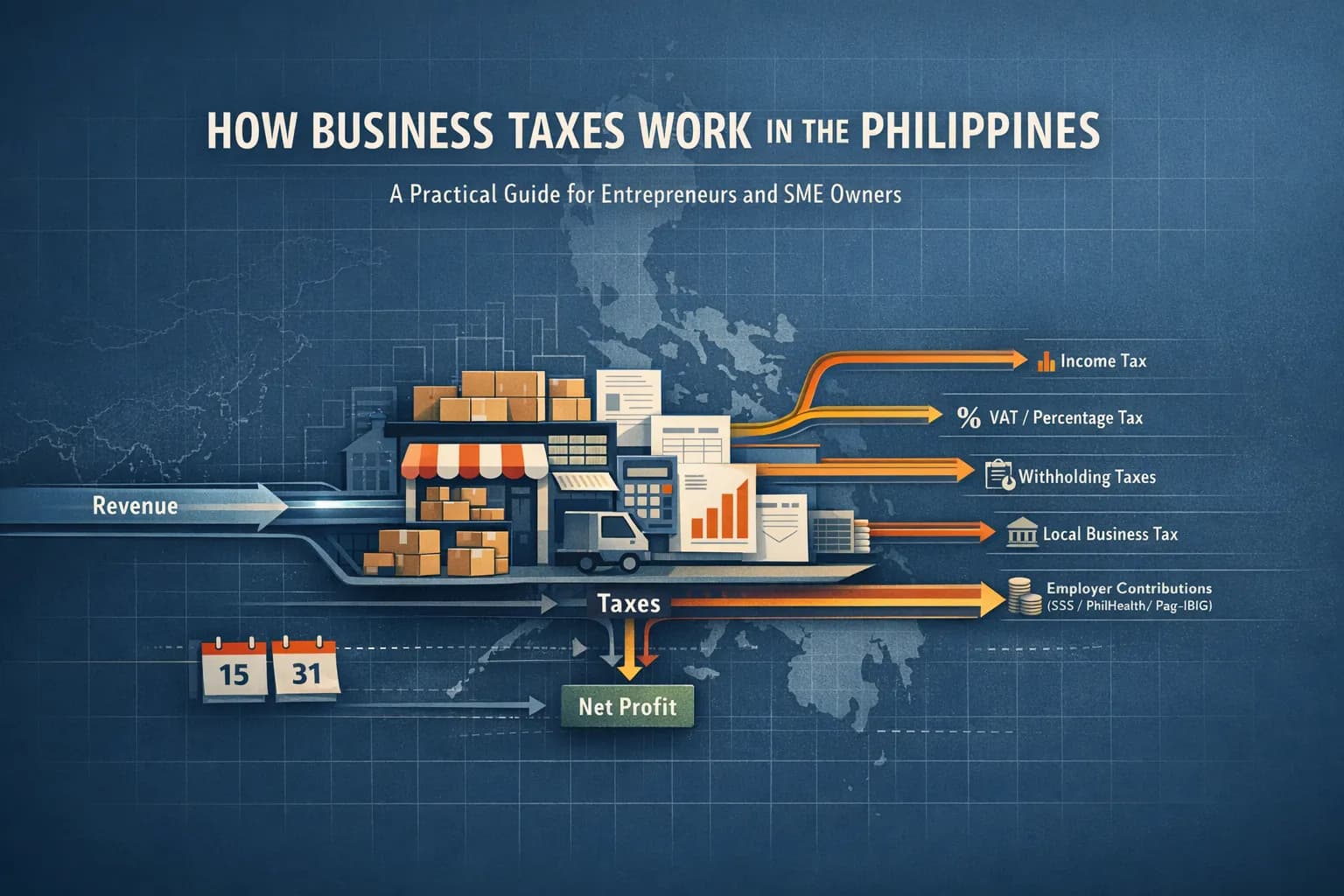
A typical business may deal with several types of taxes at the same time, including:
- Income tax
- Value-Added Tax (VAT) or Percentage Tax
- Withholding taxes
- Local business taxes
- Employer contributions (SSS, PhilHealth, Pag-IBIG)
Even small businesses must track these obligations carefully. It adds up faster than most first-time entrepreneurs expect.
Tax compliance generally requires businesses to:
- Register with the BIR
- Maintain books of accounts
- Issue official receipts or invoices
- File periodic tax returns
- Pay taxes according to scheduled deadlines
Failure to comply may result in penalties, surcharges, interest, or even closure of business operations.
How Philippine Business Taxes Differ by Business Structure
The structure of your business significantly affects how you are taxed and how complex your compliance obligations become. Choosing the right structure early can save you considerable time and money down the road.
Sole Proprietorship
A sole proprietorship is the simplest business form — owned and operated by one person with no separate legal personality from the owner.
Key characteristics:
- Single owner
- No corporate veil — the owner has unlimited personal liability
- Easiest to register and maintain
Tax treatment:
Business income is treated as personal income of the owner.
Owners pay either:
- Graduated personal income tax (0–35%), or
- An optional 8% flat tax on gross sales if annual revenue does not exceed ₱3,000,000 (the current VAT threshold)
The 8% option replaces both the graduated income tax and the 3% percentage tax, which makes compliance significantly simpler for small businesses. For many Filipino entrepreneurs just starting out, this is the most practical route.
More details on the tax options are summarized in the PwC Philippines tax overview.
Compliance complexity: Low to moderate.
This structure is common among freelancers, consultants, small retail operations, and online sellers.
Partnerships
A partnership involves two or more individuals operating a business together.
Liability: Partners may be personally liable for partnership obligations depending on the partnership type.
Tax treatment:
Most partnerships are taxed similarly to corporations. However, General Professional Partnerships (GPPs) — such as law firms or accounting practices — are treated differently. The partnership itself is not taxed; instead, each partner reports their share of profits on their personal tax returns. This rule is outlined in the Philippine tax code and clarified in BIR circulars.
Compliance complexity: Moderate. Partnerships require partnership agreements, proper accounting records, and regular income tax filings.
Corporations
Corporations are separate legal entities registered with the Securities and Exchange Commission (SEC).
Liability: Shareholders have limited liability, meaning personal assets are generally protected from business debts.
Tax treatment:
Corporations pay Corporate Income Tax (CIT) at the following rates:
- 25% standard corporate income tax
- 20% reduced rate for small corporations with net taxable income below ₱5 million and total assets not exceeding ₱100 million
These rates were introduced under the Corporate Recovery and Tax Incentives for Enterprises (CREATE) Act and are summarized in the PwC Philippines corporate tax guide.
Corporations may also be subject to a Minimum Corporate Income Tax (MCIT) if regular income tax falls below a specified threshold after several years of operations.
Compliance complexity: High. Corporations must maintain audited financial statements, board resolutions, and regulatory filings with both the BIR and the SEC.
One Person Corporations (OPC)
A One Person Corporation is a relatively new business form — a corporation owned by a single individual, introduced under the Revised Corporation Code.
OPCs give entrepreneurs the benefit of limited liability without needing multiple shareholders. It is an increasingly popular option for Filipino business owners who want asset protection but do not have co-founders.
Tax treatment: OPCs are taxed the same way as regular corporations. They cannot use the simplified 8% tax option available to sole proprietors. However, corporations generally have access to broader deductions and more strategic tax planning options.
Compliance complexity: Higher than sole proprietorships, but often preferred for asset protection, long-term business continuity, and investor readiness.
Common Types of Taxes Philippine Businesses Must File
Most businesses in the Philippines deal with several major taxes simultaneously. Here is what each one looks like in practice.
Income Tax
Income tax is based on net taxable income — what remains after allowable deductions.
Rates depend on your business structure:
| Entity | Tax Rate |
|---|---|
| Individuals / Sole Proprietors | 0–35% graduated tax |
| Small corporations | 20% |
| Standard corporations | 25% |
Businesses typically file quarterly and annual income tax returns with the BIR. Missing a quarterly deadline is one of the most common mistakes new business owners make.
Value Added Tax (VAT)
VAT is a 12% consumption tax applied to the sale of goods and services in the Philippines.
Businesses must register for VAT if their annual gross sales exceed ₱3,000,000, the current VAT threshold referenced in the PwC Philippines tax summary.
VAT-registered businesses:
- Charge 12% VAT on sales
- Claim input VAT credits on purchases
- File VAT returns on a regular schedule
For trading companies and distributors moving high volumes, VAT management becomes a core part of financial operations — not an afterthought.
Percentage Tax
Businesses with annual sales below the ₱3,000,000 VAT threshold may pay Percentage Tax instead.
The standard rate is 3% of gross quarterly receipts, commonly applied to small non-VAT businesses. A practical overview of this tax is available in guides explaining the Philippine percentage tax system.
Withholding Taxes
Businesses frequently act as withholding agents — meaning they deduct tax from certain payments before releasing funds to the payee.
Common examples include:
- Employee salary withholding tax
- Withholding tax on professional fees (e.g., payments to consultants or freelancers)
- Withholding tax on supplier payments
These amounts must be remitted to the BIR on behalf of the payee. If you hire contractors or pay professional service providers, this responsibility applies to you.
Local Business Taxes
Local governments impose Local Business Tax (LBT) under the Local Government Code of the Philippines.
The tax is based on gross receipts from the previous year, and rates vary by city or municipality:
- Roughly 1% for manufacturers
- Up to 3% for service or trading businesses
In practice, this means a business operating in Makati pays a different LBT rate than one registered in Manila or Cebu. Local tax authority and rate structures are explained in guides to local business taxation in the Philippines.
Employer Contributions
If you have employees, mandatory payroll contributions add a significant layer of cost.
Typical contribution rates include:
| Contribution | Rate |
|---|---|
| SSS | ~15% total (10% employer, 5% employee) |
| PhilHealth | ~5% total (2.5% each) |
| Pag-IBIG | ~4% total (2% each) |
Recent updates to the SSS contribution structure are discussed in policy summaries such as the KPMG overview of Philippine social security contributions.
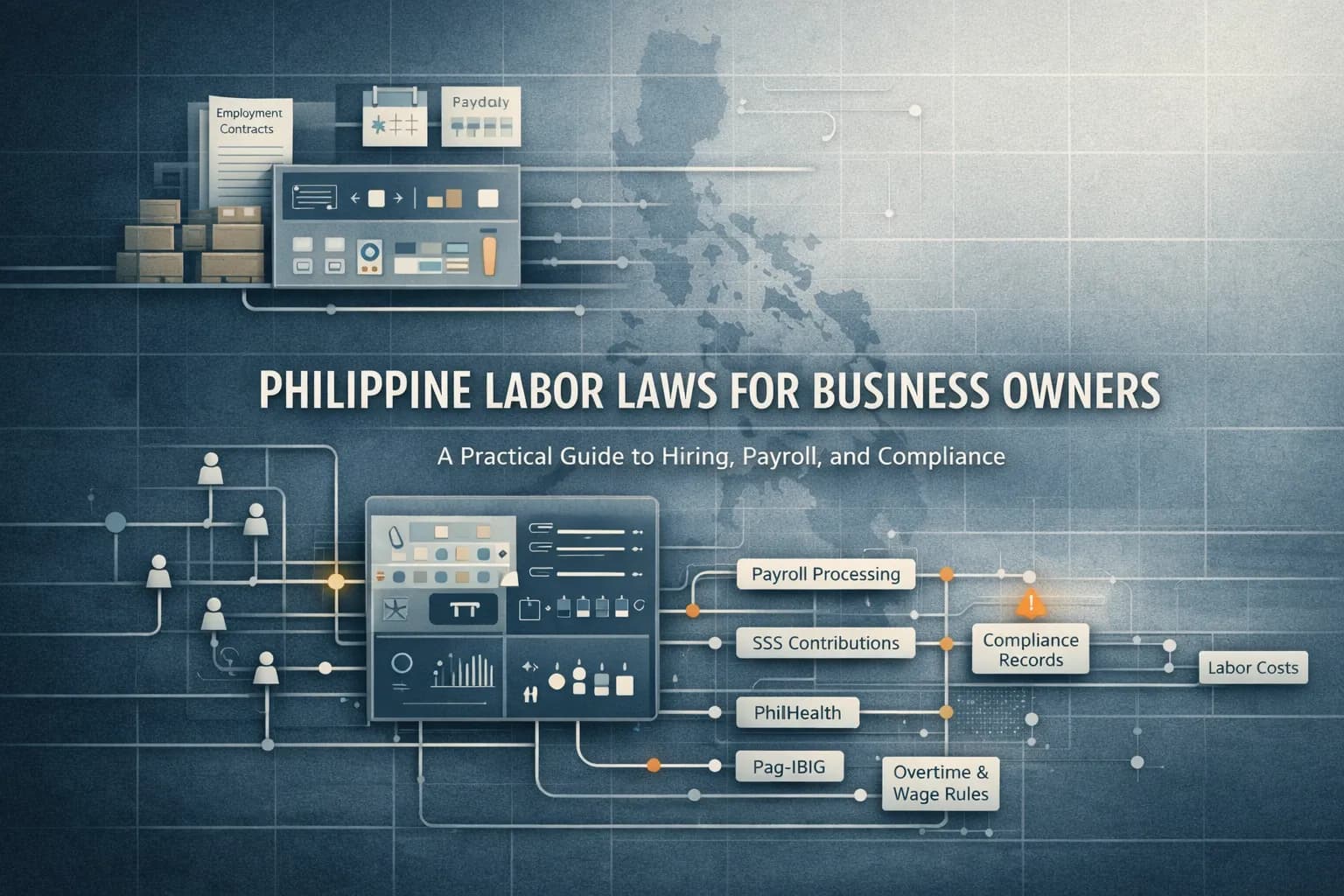
These contributions add roughly 20–25% to your total payroll costs. Many first-time employers in the Philippines are surprised by this number — it is one of the most commonly underestimated operational expenses. For a deeper look at employer obligations, see our guide to Philippine labor laws for business owners.
Basic Tax Filing Workflow for Philippine Businesses
1. Register with the BIR
Before you can legally operate, you need to secure:
- A Taxpayer Identification Number (TIN)
- A Certificate of Registration (COR)
- Authority to print official receipts
Registration also determines whether your business is classified as VAT-registered or non-VAT — a distinction that affects your filing obligations going forward.
2. Maintain Books of Accounts
The BIR requires businesses to maintain records of:
- Sales and revenue
- Expenses and purchases
- Payroll
- Inventory
These books allow the BIR to verify whether your taxes are computed correctly. During audits, incomplete or disorganized records are one of the most common reasons businesses face additional assessments.
3. Issue Official Receipts and Invoices
Every sale must be properly documented through:
- Official Receipts (for services)
- Sales Invoices (for goods)
Failure to issue receipts is one of the most common compliance violations — and one of the easiest to avoid.
4. File Periodic Tax Returns
Filing schedules pile up quickly:
| Filing Type | Frequency |
|---|---|
| Income tax | Quarterly + annual |
| VAT | Monthly or quarterly |
| Percentage tax | Quarterly |
| Withholding taxes | Monthly |
Missing deadlines typically results in a 25% surcharge, interest on unpaid taxes, and administrative penalties. A single missed filing can trigger a cascade of costs that erodes your margins.
What Philippine Business Owners Should Prepare For
Tax compliance in the Philippines is operationally demanding. Here is what entrepreneurs should realistically budget time and resources for.
Accounting Systems
Even small businesses should implement basic accounting or bookkeeping tools early. Accurate records reduce errors, simplify tax filing, and make BIR audits far less stressful. Spreadsheets work at first, but most growing businesses eventually need dedicated software. Tools like Luxium's Cashflow App can help SMEs track financial obligations alongside day-to-day operations.
Documentation Requirements
Businesses must retain invoices, receipts, purchase records, payroll documents, and financial statements. The BIR may request these during audits, and producing them after the fact is rarely possible. The best time to organize your records is before you need them.
Compliance Deadlines
Many SME owners underestimate how many deadlines exist in a single year. Monthly, quarterly, and annual filings accumulate quickly, and each has its own form number and submission process. Failure to track these is one of the most common — and most costly — compliance risks.
Penalties and Enforcement
The BIR may impose surcharges, interest charges, compromise penalties, and in severe cases, business closure orders. Most compliance failures stem from poor documentation and missed deadlines rather than intentional evasion. The system is not designed to be punitive, but it does require discipline.
How Tax Planning Affects Business Operations in the Philippines
Taxes are not separate from your business strategy — they are embedded in every operational decision you make.
Pricing Strategy
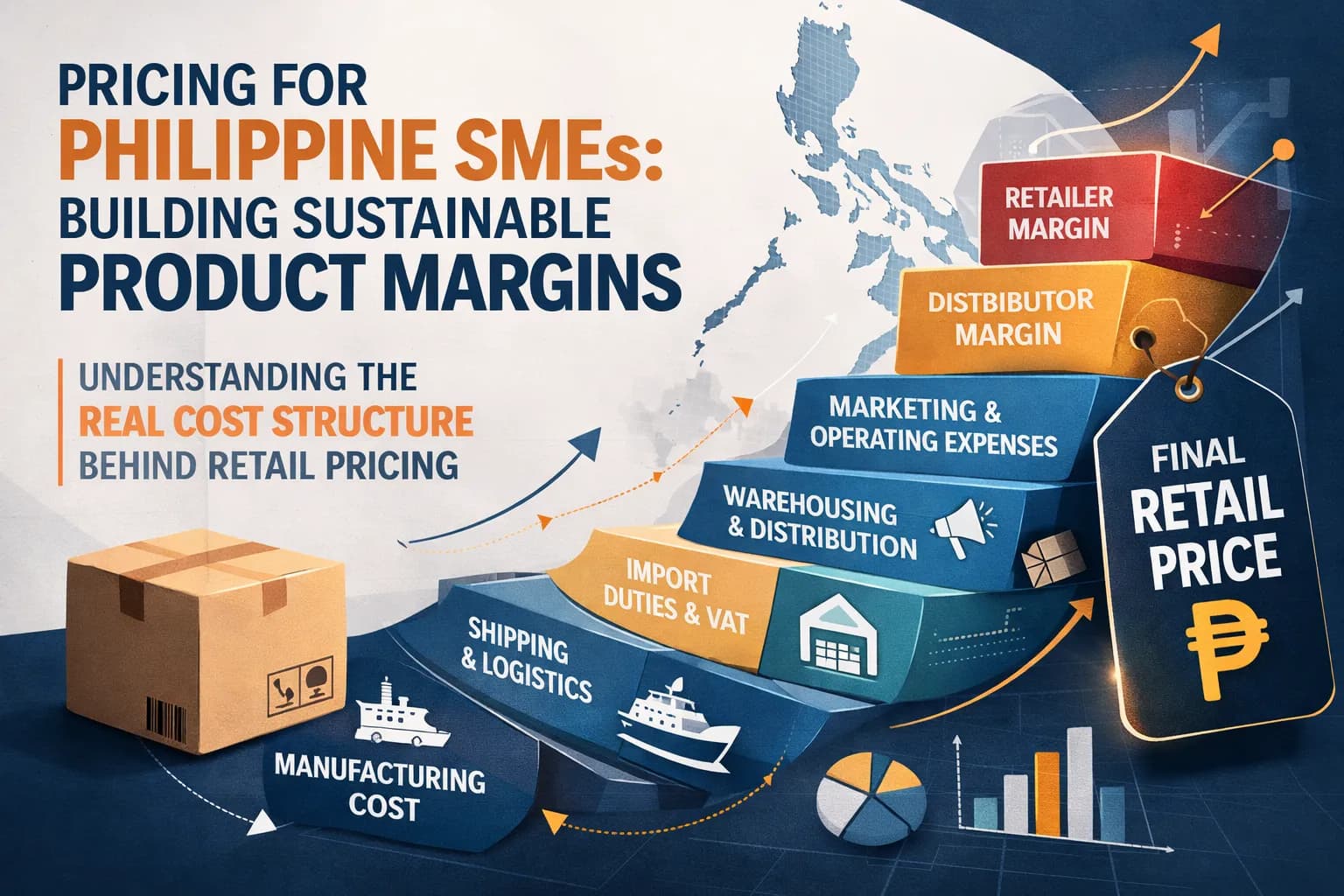
You must account for VAT or percentage tax when setting prices. A ₱100 product with 12% VAT becomes ₱112 at retail if the tax is passed to the customer. Many Philippine SMEs learn this lesson the hard way — as we covered in our guide to building sustainable product margins, ignoring taxes when pricing can quietly erase margins over months.
Profit Margins
Income tax reduces net profit directly. A corporation paying 25% CIT needs significantly higher operating margins than a sole proprietor using the simplified 8% scheme to achieve the same take-home income.
Cost Structure
Payroll costs increase substantially when statutory contributions are included. Employers may pay 15–25% in additional labor costs beyond base salaries. When you are hiring your fifth or tenth employee, that gap becomes a serious line item.
Financial Planning
Taxes affect cash flow in ways that are easy to overlook. Many businesses set aside 10–30% of revenue for tax obligations depending on their structure and profitability. Poor tax planning can create real liquidity problems during quarterly filing periods — especially for trading companies and distributors with thin margins.
Key Takeaways
- The Philippine tax system combines national taxes and local government taxes, and both apply to most businesses.
- Tax obligations vary significantly depending on whether you operate as a sole proprietor, partnership, corporation, or OPC.
- Most businesses must deal with income tax, VAT or percentage tax, withholding taxes, and payroll contributions — often simultaneously.
- Compliance requires consistent accounting records, disciplined filing schedules, and awareness of deadlines.
- Taxes directly affect pricing, payroll costs, profit margins, and long-term financial planning.
Understanding the structure of the system does not make taxes easy — but it does allow entrepreneurs to design better financial strategies, avoid costly compliance mistakes, and build businesses that can sustain growth over time.