Beyond Foot Traffic: Why Conversion Rate Matters More Than Mall Visitors
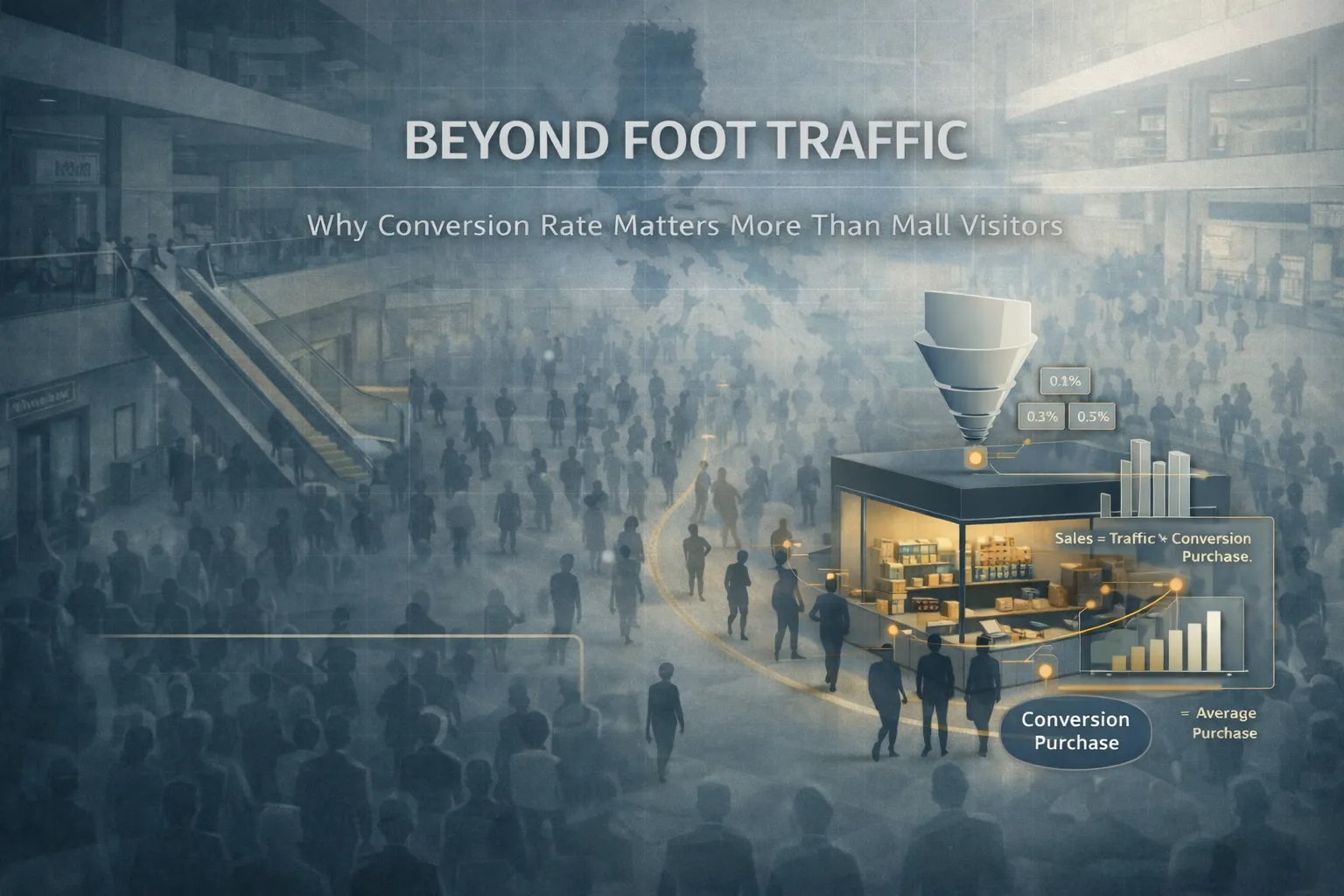
Why Retail Success Depends on Turning Shoppers Into Buyers
Mall operators frequently highlight one metric when pitching retail space: foot traffic. A location with tens of thousands of daily visitors sounds like a guaranteed opportunity.
But for small retailers — especially kiosks, pop-ups, and niche consumer brands — foot traffic alone is often a misleading signal.
Retail performance depends on conversion rate, not raw visitor volume.
Conversion rate measures the percentage of people who actually purchase after encountering your store. In retail analytics, it is defined as the proportion of store visitors who complete a transaction (TruRating retail conversion analysis).
A mall may attract thousands of visitors, but if only a tiny fraction convert, sales remain limited.
For entrepreneurs operating kiosks, pop-ups, and specialty retail concepts in the Philippines, understanding this distinction can prevent costly location mistakes.
The Conversion Reality of Mall Retail
Retail revenue follows a simple equation:
Sales = Traffic × Conversion Rate × Average Transaction Value
If conversion is weak, high traffic alone cannot produce strong sales.
Example: Mall With 40,000 Daily Visitors
If a mall receives 40,000 visitors per day, the actual number of buyers may be far smaller.
| Conversion Rate | Estimated Buyers |
|---|---|
| 0.1% | 40 buyers |
| 0.3% | 120 buyers |
| 0.5% | 200 buyers |
Even with heavy traffic, a kiosk might realistically see 40–200 daily transactions depending on execution.
If the average purchase value is ₱500, revenue may look like this:
| Conversion Rate | Daily Revenue |
|---|---|
| 0.1% | ₱20,000 |
| 0.5% | ₱100,000 |
This explains why many retailers enter high-traffic malls but still struggle to cover rent and operating costs.
Small changes in conversion can have major financial impact. Retail studies show that even minor improvements in conversion rate can generate significant revenue growth without increasing traffic.
For SME retailers, improving conversion is often far more realistic than increasing foot traffic.
Why High Foot Traffic Often Fails to Convert
Large visitor counts do not automatically translate into buyers. Several operational factors determine whether traffic turns into revenue.
Product Visibility
In crowded malls, many stores are simply overlooked.
A kiosk has only a few seconds to communicate what the product is, why it matters, and how much it costs. If passersby cannot understand the offer immediately, they keep walking.
Retail conversion studies highlight common friction points that reduce purchases, including unclear product presentation, confusing layouts, or difficulty finding the right item.
Clear signage, simple displays, and visible pricing dramatically increase the chances that shoppers will stop.
Price Accessibility
Even if shoppers notice your store, pricing must match the mall's typical audience.
A premium product placed in a price-sensitive environment will struggle to convert. Location analysis research shows that product-market mismatch is a major reason high-traffic locations fail to produce strong sales.
Retailers should examine local demographics, income levels, whether the crowd skews student or professional, and typical spending habits. A kiosk selling premium gaming devices, for example, may perform better in malls near business districts than in malls dominated by student traffic.
Product Demonstration
Many specialty products require explanation or experience before customers feel comfortable buying.
Demonstration significantly increases conversion in categories like electronics, gaming accessories, collectibles, and hobby products. When shoppers can see a product in action, uncertainty drops. This is why demonstration areas are common in high-performing electronics stores — hands-on interaction shortens the decision process and improves purchase confidence.
Customer Intent
Here is the part that catches most new retailers off guard: not every mall visitor is there to shop.
Shopping centers in the Philippines function as social hubs. People visit to dine, watch movies, attend events, meet friends, or simply escape the heat. Research shows consumers frequently visit malls for everyday activities beyond retail shopping.
Large Philippine mall operators report millions of visitors weekly as malls function as social and community spaces rather than purely retail environments.
This means a significant share of foot traffic may have no intention to buy retail products at all. Understanding visitor intent matters more than counting people. This is also why targeted retail environments like pop-up events and bazaars can outperform mall locations — the audience is already there with purchase intent.
Audience Fit vs Traffic Volume
Many entrepreneurs assume the biggest mall automatically offers the best opportunity. But smaller malls with the right audience can outperform high-traffic locations.
Location research highlights several factors that matter more than visitor volume.
Demographics
Retailers should evaluate whether nearby shoppers match their target market — age group, income level, lifestyle interests, and occupation. These demographic and psychographic indicators strongly influence retail conversion.
Category Demand
Past retail performance can reveal whether a location supports a product category. If similar products consistently struggle in a mall, the issue may not be traffic but demand.
Complementary Stores
Retail environments function as ecosystems. Stores benefit from proximity to complementary businesses — gaming accessories near electronics retailers, toys near family-oriented areas, lifestyle products near cafés and entertainment venues. Retail clusters help attract the right customers.
Competition Density
Too many similar stores divide demand. High-traffic malls often contain intense competition, reducing sales per store. Retail location research warns that crowded markets frequently lead to price pressure and lower profitability.
Placement Within the Mall
A kiosk's specific position inside the mall can significantly influence sales. Visibility near escalators, entrances, food courts, or entertainment zones can dramatically improve conversion. Even within the same mall, two locations may perform very differently.
Customer Experience as a Conversion Driver
In modern retail, most products are available online. Customers can compare prices instantly. Product availability alone rarely drives sales anymore.
What cannot be replicated online is the in-person experience. Research shows that store staff engagement, product clarity, and layout all affect whether visitors convert into buyers.
Staff Interaction
Sales associates who actively engage customers improve conversion. Simple discovery questions can identify needs: "What will you use this for?" "Is this for yourself or as a gift?" "What features matter most?" This conversation guides shoppers toward the right product — and when the recommendation feels genuine, the sale follows naturally.
Product Education
Customers often hesitate when product differences are unclear. Explaining features, use cases, and comparisons removes uncertainty. In technical categories like electronics or gaming, knowledgeable staff significantly increase purchase confidence.
Store Environment
Even small kiosks benefit from thoughtful layout — uncluttered displays, clear pricing, easy product access. These elements reduce friction and speed up purchasing decisions. A customer who can find what they want, understand what it costs, and feel confident in their choice will buy.
Strategic Lessons for Philippine Retailers
For entrepreneurs considering mall retail, several practical lessons emerge from conversion thinking.
Evaluate conversion expectations honestly. Before signing a lease, estimate realistic conversion rates using conservative assumptions — not the mall's marketing numbers.
Prioritize audience fit over traffic volume. Choose locations where shoppers already align with your product category. A smaller mall with the right crowd will often outperform a mega-mall where your product is irrelevant to most visitors.
Focus on operational execution. Conversion improves when retailers invest in clear product presentation, demonstrations, trained staff, and simple pricing communication. These operational improvements often generate better returns than expensive marketing campaigns.
Track what actually matters. Monitor conversion rate, average transaction value, and sales per square meter. These indicators provide a far more accurate picture of store performance than foot traffic alone. Our ToyCon Philippines case study shows how these metrics play out in a high-traffic event environment.
Conclusion
Foot traffic is the most visible metric in mall retail, but it is rarely the most important one.
High visitor numbers create the illusion of opportunity. In practice, only a small percentage of mall visitors convert into customers — and for niche retailers, that percentage can be uncomfortably small if the fundamentals are not in place.
Retail success depends on audience alignment, product clarity, store execution, and staff engagement. The retailers who understand this build profitable operations in locations that others dismiss. The ones who chase traffic numbers alone often end up paying premium rent for disappointing sales.
For companies involved in sourcing, distribution, and physical retail operations in the Philippines, the lesson is straightforward: retail is not a traffic game — it is a conversion game.